A 6mm ARC Trajectory Chart is a detailed ballistic table that displays the exact bullet drop and flight path of various factory loads across different distances. This essential reference guide helps hunters and precision shooters understand exactly how modern cartridges perform when traveling downrange toward a target. By studying these ballistic values you can easily determine the optimal zero distance for your rifle and confidently calculate precise holdovers for extended shots. Reviewing this comprehensive data ensures you will select the perfect ammunition for your specific shooting environment and achieve ethical hits every time you pull the trigger.
6mm ARC Trajectory Chart
| Manufacturer | Bullet Weight | Bullet Type | Ballistic Coefficient | Sectional Density | Muzzle Velocity | 50 Yard Drop | 100 Yard Drop | 150 Yard Drop | 200 Yard Drop | 250 Yard Drop | 300 Yard Drop | Recommended Zero Distance | Maximum Point Blank Range |
| Hornady | 108 Grain | ELD Match | 0.536 | 0.261 | 2750 FPS | Rise 1.0 | Rise 1.9 | Rise 1.5 | Zero | Drop 2.9 | Drop 7.6 | 200 Yards | 235 Yards |
| Hornady | 105 Grain | BTHP Black | 0.530 | 0.254 | 2750 FPS | Rise 1.0 | Rise 1.9 | Rise 1.5 | Zero | Drop 3.0 | Drop 7.8 | 200 Yards | 235 Yards |
| Hornady | 103 Grain | ELD X Hunter | 0.512 | 0.249 | 2800 FPS | Rise 0.9 | Rise 1.8 | Rise 1.4 | Zero | Drop 2.8 | Drop 7.3 | 200 Yards | 240 Yards |
| Hornady | 80 Grain | ELD VT Match | 0.410 | 0.193 | 3020 FPS | Rise 0.7 | Rise 1.3 | Rise 1.0 | Zero | Drop 2.3 | Drop 6.2 | 200 Yards | 255 Yards |
| Hornady | 90 Grain | CX Custom | 0.392 | 0.218 | 2900 FPS | Rise 0.8 | Rise 1.5 | Rise 1.2 | Zero | Drop 2.6 | Drop 6.9 | 200 Yards | 245 Yards |
| Federal | 108 Grain | Berger OTM | 0.534 | 0.261 | 2950 FPS | Rise 0.7 | Rise 1.5 | Rise 1.1 | Zero | Drop 2.4 | Drop 6.3 | 200 Yards | 250 Yards |
| Copper Creek | 105 Grain | Berger Hybrid | 0.536 | 0.254 | 2750 FPS | Rise 1.0 | Rise 1.9 | Rise 1.5 | Zero | Drop 2.9 | Drop 7.6 | 200 Yards | 235 Yards |
| Copper Creek | 95 Grain | Nosler Ballistic | 0.379 | 0.230 | 2850 FPS | Rise 0.8 | Rise 1.6 | Rise 1.3 | Zero | Drop 2.7 | Drop 7.2 | 200 Yards | 240 Yards |
| Copper Creek | 87 Grain | V MAX | 0.400 | 0.210 | 2950 FPS | Rise 0.7 | Rise 1.5 | Rise 1.1 | Zero | Drop 2.5 | Drop 6.5 | 200 Yards | 250 Yards |
| Copper Creek | 80 Grain | Barnes TTSX | 0.331 | 0.193 | 3000 FPS | Rise 0.7 | Rise 1.4 | Rise 1.1 | Zero | Drop 2.5 | Drop 6.8 | 200 Yards | 250 Yards |
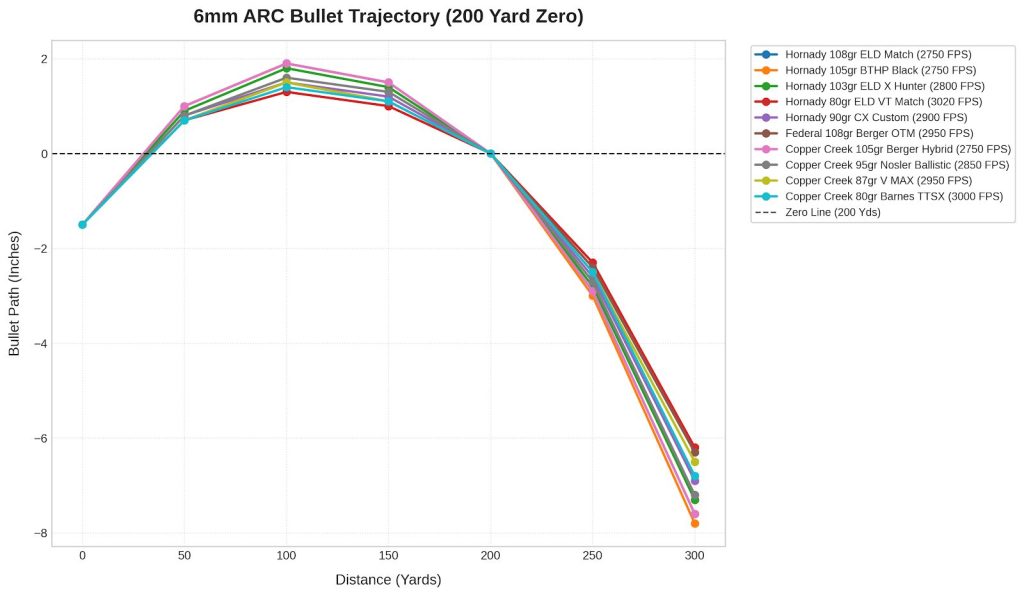
This professional trajectory chart provides shooters with precise bullet drop measurements across various distances so they can accurately compensate for gravity when aiming. You should always match your chosen factory load with the recommended zero distance to maximize your effective hunting range and ensure ethical shots in the field.
Understanding The 6mm ARC Trajectory Chart
Trajectory Analysis
The trajectory table reveals that most standard factory loads remain remarkably flat out to two hundred yards. Shooters will notice a steep increase in bullet drop once the projectile passes that critical three hundred yard mark.
Hornady offers the flattest shooting factory ammunition shown in our comprehensive data with their eighty grain bullet. This high velocity round maintains an incredibly tight trajectory that essentially eliminates complex holdover calculations in the field.
The eighty grain polymer tipped bullet from Hornady drops barely six inches at three hundred yards. This impressive measurement clearly outperforms traditional heavy loads across similar hunting distances.
Traditional target loads drop slightly more at three hundred yards than modern lightweight varmint bullets. The data shows roughly seven and a half inches of drop at three hundred yards for these heavier projectiles.
Understanding these distinct trajectory profiles ensures you never guess where your bullet will strike. You can confidently place the crosshairs perfectly on the vitals of your target animal every single time.
Velocity Analysis
Muzzle velocity plays a critical role in how modern cartridges perform downrange in hunting environments. Faster initial speeds directly translate into flatter trajectories and extended point blank hunting ranges.
The Hornady eighty grain match load represents the absolute fastest factory option available today. It leaves the muzzle at a blistering three thousand twenty feet per second.
Heavier one hundred eight grain bullets leave the barrel much slower and therefore experience more severe drop at extended ranges. The standard Hornady match load only generates two thousand seven hundred fifty feet per second at the muzzle.
This massive difference in velocity perfectly illustrates why hunters must test their chosen ammunition carefully. A faster bullet arrives at the target quicker and spends less time fighting the downward pull of gravity.
Velocity also dictates how reliably hunting bullets will expand upon impacting heavy animal tissue. Bullets that slow down too much before reaching the target may fail to mushroom correctly.
Ballistic Coefficient Analysis
Ballistic coefficient measures how efficiently a bullet cuts through the air and resists drag during flight. The higher this numerical value is the better the bullet will retain its initial muzzle velocity.
The Hornady one hundred eight grain match load features the highest ballistic coefficient which greatly helps it over long distances. Its impressive zero point five three six rating helps it maintain momentum despite slower starting speeds.
Federal pushes their similar target load exceptionally fast which retains velocity exceptionally well. Their aerodynamic design yields a highly respectable ballistic coefficient of zero point five three four.
Bullets with much lower ballistic coefficients lose their velocity rapidly as they push through dense atmospheric air. The Copper Creek eighty grain solid copper round features a very low coefficient which explains its steeper drop beyond three hundred yards.
Studying these efficiency ratings helps precision shooters select ammunition that cheats the wind effectively. Highly efficient bullets always deliver more kinetic energy to the target at longer distances.
Best Hunting Loads Based On The Chart
Whitetail deer hunters should immediately pick the Hornady one hundred three grain precision hunter load. This specific cartridge provides massive energy transfer and deep penetration on medium sized game animals.
Predator hunters specifically targeting coyotes will find the eighty grain Hornady match round completely devastating. The extreme velocity guarantees a totally flat trajectory out to two hundred fifty yards with explosive terminal performance.
Wild hogs possess thick hide and dense bone structure that require extremely deep penetrating bullets. The Copper Creek eighty grain solid copper hollow point delivers unmatched penetration and flawless weight retention for large feral hogs.
Shooters operating in dense timber environments should strongly consider the Hornady ninety grain custom load. The monolithic copper alloy construction ensures flawless weight retention even if the bullet clips small brush before impact.
Marksmen shooting heavy steel targets at extreme distances need maximum ballistic efficiency. The Federal one hundred eight grain target load provides perfectly consistent velocities required for hitting small plates far away.
Key Takeaways From The Chart
Our extensive trajectory data highlights the true capabilities and limitations of this highly popular military designed cartridge. By analyzing the numbers you can make fully informed decisions about your ammunition selection.
The Hornady eighty grain match load delivers the absolute flattest trajectory among all evaluated commercial options. It represents a massive technological leap forward for hunters demanding extreme precision from modern sporting rifles.
Federal offers the absolute best premium match load for competitive shooters pushing past one thousand yards. Their optimized powder charge drives heavy aerodynamic bullets significantly faster than standard factory ammunition.
The cartridge easily provides a maximum point blank range extending well past two hundred forty yards with most hunting loads. This impressive capability completely eliminates complicated mental math during fast paced hunting scenarios.
Many shooters mistakenly assume heavy bullets always drop significantly more than lighter alternatives at every distance. However the highly efficient aerodynamic design of heavy target bullets allows them to eventually overtake lighter bullets at extreme distances.
Common 6mm ARC Bullet Weights
80 Grain
Lightweight eighty grain bullets are specifically engineered to maximize velocity and flatten the trajectory curve dramatically. These specialized projectiles fly incredibly straight and require almost zero holdover adjustments at typical woodland hunting distances.
The primary advantage includes incredibly mild recoil and truly explosive terminal performance on small varmints. The exceptionally low mass allows standard powder charges to accelerate the bullet to extraordinary speeds very quickly.
Hunters should strictly avoid using these ultra light bullets on large game animals like elk or heavy bears. They severely lack the required sectional density needed to achieve deep penetration through thick muscle and dense bone.
Coyote and predator hunters will find these specialized loads exceptionally effective for mid range open country encounters. The bullet essentially fragments upon impact which drastically reduces the risk of dangerous ricochets in rocky terrain.
Finding these unique loads on local store shelves is becoming much easier as the caliber gains massive mainstream popularity. Shooters can also order them directly from custom ammunition manufacturers online without any hassle.
90 Grain
The ninety grain projectile serves as an excellent middle ground for hunters demanding both velocity and structural integrity. These bullets typically leave the muzzle at two thousand nine hundred feet per second and provide outstanding terminal ballistics.
The main advantage is widespread retail availability and a highly predictable trajectory curve out to three hundred yards. Many manufacturers utilize solid copper construction for this specific weight to guarantee maximum weight retention.
One minor disadvantage is that the ballistic coefficient remains slightly lower than heavy target bullets. However no game animal on earth will ever notice a slight reduction in aerodynamic efficiency at normal hunting ranges.
This weight remains a spectacular choice for typical whitetail deer hunting applications across the entire country. Countless hunters rely on this exact bullet mass to fill their freezers every single hunting season with complete confidence.
The recoil generated by these loads remains entirely negligible for the vast majority of adult and youth shooters. You can comfortably practice at the gun range all day without experiencing any shoulder fatigue whatsoever.
103 Grain
Hornady specifically designed their one hundred three grain hunting bullet to perfectly optimize the internal case capacity of the cartridge. These reliable projectiles travel at two thousand eight hundred feet per second and perfectly mirror the trajectory of premium match ammo.
Hunters truly appreciate the noticeably better penetration these heavier bullets offer on tough quartering away shots. The added mass helps drive the expanding polymer tipped bullet incredibly deep into the vital cavity of large animals.
The only real drawback is a microscopically reduced muzzle velocity compared to the lighter eighty grain alternatives. The slight reduction in speed is completely offset by the massive increase in delivered kinetic energy upon impact.
These loads perform phenomenally well for hunters specifically targeting large mule deer and mature wild hogs. The robust jacket construction ensures the bullet stays perfectly intact during the most demanding high speed impacts.
Many competitive target shooters also favor this weight for hitting steel plates at intermediate distances. The additional momentum rings heavy steel targets with undeniable authority during fast paced shooting matches.
105 Grain
Premium one hundred five grain bullets remain the absolute gold standard for competitive precision rifle shooters worldwide. These specialized projectiles exhibit a slightly more pronounced arc but cheat the wind better than anything else available.
The absolute greatest advantage of this specific bullet weight is its ability to maintain supersonic flight past one thousand yards. The incredibly high ballistic coefficient guarantees the projectile cuts through dense air with maximum efficiency.
Shooters will never notice any increased felt recoil when stepping up to this heavier mass class in gas operated rifles. The smooth recoil impulse allows marksmen to spot their own impacts through the optic without losing the target.
This bullet weight truly excels when engaging tiny steel targets during demanding precision rifle series matches. The incredible consistency guarantees perfectly placed shots even when dealing with tricky shifting crosswinds.
Handloaders frequently choose this exact weight when building custom ammunition for extreme long range target practice. It represents the perfect combination of high velocity and remarkable aerodynamic performance.
108 Grain
One hundred eight grain bullets represent the absolute maximum practical weight for this advanced cartridge design. These exceptionally heavy projectiles leave the barrel slightly slower but retain their momentum flawlessly across vast distances.
The incredible aerodynamic efficiency makes these bullets virtually immune to light crosswinds at typical shooting distances. They hit with impressive force that clearly rings heavy steel targets placed way out at one thousand two hundred yards.
Marksmen must accurately calculate their specific holdovers because the trajectory arcs slightly more at intermediate ranges. Dialing the correct elevation into your optic guarantees perfect impacts regardless of the heavy bullet drop.
These loads are absolutely perfect for tactical competitions and military applications requiring extreme long range precision. In these highly demanding environments the heavy bullet completely outperforms traditional intermediate cartridges.
The felt recoil produced by one hundred eight grain loads remains incredibly mild and totally manageable for any shooter. Small framed shooters will find the gentle push quite comfortable during extended weekend practice sessions.
Effective Hunting Range
Deer
Whitetail deer hunters can confidently engage targets out to five hundred yards with proper ammunition and a solid rest. This impressive distance firmly establishes the cartridge as a highly capable open field hunting option for modern sportsmen.
Polymer tipped bullets maintain enough velocity and energy to ensure ethical expansion at these extended distances. You must always verify your exact bullet drop data before attempting challenging shots across massive agricultural fields.
The cartridge truly shines when hunters completely understand their exact trajectory data and environmental conditions. Knowing your precise holdover points guarantees a clean and highly ethical harvest every single time you pull the trigger.
Wild Hog
Feral hogs feature thick cartilage shields over their shoulders that require maximum energy for deep reliable penetration. These dense biological armor plates have successfully stopped numerous lightweight varmint bullets dead in their tracks.
Hunters should strictly limit their shots to four hundred yards to guarantee the bullet retains enough kinetic energy. Piercing the protective armor requires every ounce of striking force the heavy hunting bullets can safely deliver.
A well placed shot directly behind the ear remains the absolute best method for dropping large boars instantly. The highly accurate cartridge completely destroys the central nervous system upon impact when placed correctly.
Varmints And Predators
Coyote hunting typically takes place at unknown distances over vast open prairies or massive rolling hills. The vital zone of a coyote is relatively small and demands extreme precision from your chosen rifle system.
The maximum ethical range on coyotes easily extends to roughly six hundred yards in calm wind conditions. This incredible distance ensures devastating performance upon impact which totally prevents long tracking situations.
Choosing light and fast constructed bullets guarantees the projectile will expand violently upon initial impact. Always wait for the predator to pause and present a broadside angle before gently squeezing the trigger.
Long Range Target Shooting
Hitting steel plates requires absolute consistency and premium match grade ammunition loaded to extreme tolerances. Competitive shooters demand cartridges capable of performing flawlessly in the most difficult environmental conditions imaginable.
Marksmen routinely engage targets out to one thousand two hundred yards using heavy one hundred eight grain bullets. The bullet remains highly predictable and stable even as it transitions back into subsonic flight speeds.
Premium bolt action rifles offer the absolute best performance for these incredible extreme distance shots. Their ability to extract maximum velocity ensures you can easily compete with much larger short action calibers.
Short Barrel Rifles
Hunting in dense vegetation severely limits visibility and completely requires compact rifle platforms for easy maneuverability. Navigating through impenetrable briars with a massive twenty four inch barrel is a total nightmare every hunter hates.
The effective range from a short sixteen inch barrel easily exceeds three hundred yards where maximum energy transfer is guaranteed. The highly efficient powder column burns completely in short barrels without creating massive fireballs.
You should always carry low magnification variable optics when running compact gas operated rifles in the woods. This allows for rapid target acquisition when fast moving animals suddenly appear at extremely close ranges.
Factors That Affect 6mm ARC Trajectory
Bullet Weight
The physical weight of the projectile fundamentally alters how the cartridge performs during sustained open air flight. Lighter bullets travel much faster and maintain a remarkably flat trajectory over the first three hundred yards.
This increased speed allows the projectile to resist the immediate pull of gravity and stay perfectly aligned with your optic. Open field hunters strongly prefer these lightweight options to completely eliminate complicated holdover math entirely.
Conversely heavier projectiles drop slightly faster because gravity acts on their slower forward momentum over a longer period. These massive bullets simply cannot cover the downrange distance fast enough to completely avoid a downward arc.
Hunters must carefully weigh the delicate balance between the flat shooting nature of light bullets and the aerodynamic efficiency of heavier alternatives. Your specific hunting environment should always heavily dictate exactly which bullet weight will perform best.
Muzzle Velocity
Higher muzzle velocities propel the bullet further downrange before gravity can pull it downward in any truly significant way. Speed remains the ultimate equalizer when trying to extend the maximum point blank range of your rifle.
Ammunition loaded to maximum safe pressures will always shoot noticeably flatter than standard pressure target loads. Boutique manufacturers frequently utilize custom blended powders to safely achieve these highly impressive velocity gains.
Variations in powder temperature can easily cause massive fluctuations in your average daily muzzle velocity. You must store your ammunition properly in climate controlled environments to ensure consistent velocity readings at the range.
Barrel Length
Longer rifle barrels provide substantially more time for expanding powder gases to aggressively accelerate the projectile before exiting. A twenty four inch barrel consistently produces higher velocities than a standard sixteen inch tactical carbine barrel.
Short carbine barrels lose considerable velocity which causes the heavy bullet to drop much earlier in its designated flight path. Hunters carrying compact rifles must properly compensate for this reduced speed by adjusting their ballistic calculators.
Bolt action rifles naturally extract slightly more velocity than gas operated modern sporting rifles using identical ammunition. The fully sealed breech of a bolt action entirely prevents any expanding gases from escaping during the firing process.
Ballistic Coefficient
Aerodynamic bullets slip through the atmosphere easily and retain their velocity incredibly well at extended distances. High ballistic coefficients dramatically reduce the rapid rate at which gravity pulls the projectile toward the earth.
Blunt flat nose bullets experience massive wind drag that slows them down quickly and drastically increases their drop rate. You should entirely avoid using these highly inefficient bullet shapes if you plan on shooting past two hundred yards.
Heavy polymer tipped bullets offer the absolute best ballistic coefficients commercially available for this specific cartridge. They perfectly provide the ultimate aerodynamic profile while ensuring rapid violent expansion upon impact with soft tissue.
Wind
Crosswinds violently push the projectiles off their intended flight path and rapidly create horizontal drift downrange. Even highly aerodynamic bullets will catch a significant amount of wind during extended flight times.
Slower lightweight bullets spend more time exposed to the wind and suffer from significantly greater horizontal deflection. Shooters must learn to accurately read exact wind speed and direction when attempting shots at six hundred yards.
Always verify your wind drift calculations using a highly reliable ballistic calculator before hunting in open environments. A sudden strong gust of wind can easily push your bullet completely off the vital zone of a deer.
Temperature
Cold winter air is incredibly dense and aggressively creates additional drag that slows bullets down faster than warm air. This dense atmospheric condition completely forces the bullet to expend extra energy simply pushing the cold air away.
Gunpowder also burns much slower in freezing temperatures which severely reduces initial muzzle velocity right out of the barrel. Always manually verify your zero data during the exact actual weather conditions you expect to hunt in.
Extreme heat can rapidly cause ammunition pressures to spike dangerously high in certain gas operated rifle platforms. Never leave your premium hunting ammunition sitting in direct sunlight during incredibly warm summer range sessions.
Altitude
High elevation environments feature incredibly thin mountain air that heavily generates very little drag on flying projectiles. The complete lack of atmospheric resistance magically allows the bullet to retain maximum velocity for incredibly long distances.
Bullets fired at high altitudes will shoot noticeably flatter and strongly retain far more energy than identical rounds at sea level. Hunters traveling from coastal regions to mountainous states must completely recheck their trajectory data upon arrival.
The rapid change in atmospheric pressure can easily shift your precise point of impact by several inches at extended ranges. Always pack enough ammunition to thoroughly test your rifle after arriving at a high elevation mountain hunting camp.
Zero Distance
The specific distance at which you sight in your rifle entirely dictates exactly where the bullet impacts at every other range. Establishing a perfectly proper zero remains the absolute rock solid foundation of accurate field marksmanship.
Choosing an optimal zero distance perfectly maximizes your point blank range and totally minimizes the need for complex holdovers. You should manually tailor your rifle zero strictly based on the typical engagement distances you encounter locally.
A poorly chosen zero distance will force you to memorize highly complicated ballistic charts in the field. Selecting the absolutely correct zero ensures you can focus entirely on making a clean ethical shot immediately.
Best Zero Distance
100 Yard Zero
A one hundred yard zero ensures absolute dead center precision at standard woodland hunting distances without any complicated math. Most hunters utilizing this standard setup can simply place the crosshairs directly on the vitals at close range.
Shooters using this specific zero must aim significantly higher when engaging targets at three hundred yards. The rapid bullet drop essentially forces you to aim slightly above the back of the animal to guarantee a lung shot.
This remains a highly popular zero choice for competitive shooters running adjustable tactical scope turrets. The simple zero completely allows marksmen to quickly dial their precise elevation adjustments from a known flat baseline.
200 Yard Zero
Setting a two hundred yard zero requires the bullet to arc nearly two inches high at the midway point of its flight. This specific setup creates a massive point blank range that introduces very little room for vertical error.
This slight midrange rise allows hunters to confidently shoot directly at the center of the chest at any distance inside two hundred fifty yards. Experienced marksmen shooting in wide open agricultural fields strongly prefer utilizing this highly aggressive setup.
You must thoroughly understand exactly how high your bullet strikes at one hundred yards before hunting with this zero. Forgetting this extremely crucial detail will inevitably result in a slightly high impact during sudden close encounters.
300 Yard Zero
A three hundred yard zero aggressively pushes the bullet trajectory nearly five inches high at intermediate distances. This extremely specialized zero caters strictly to varmint hunters completely operating in vast open plains and massive deserts.
Shooting at targets inside one hundred yards with this zero will definitively result in exceptionally high impacts. Most standard hunters find this specific zero far too limiting and complicated for general woodland hunting applications.
Only highly skilled marksmen specifically targeting tiny predators at extreme distances should ever consider utilizing this zero. It completely requires total mastery of your specific trajectory curve to avoid shooting cleanly over your target.
Maximum Point Blank Zero
The maximum point blank zero mathematically represents the absolute best compromise for general purpose hunting applications. It perfectly balances the maximum mid flight bullet rise with the inevitable long range downrange bullet drop.
This highly precise calculated zero keeps the bullet trajectory within a tight target window across all typical hunting distances. You can confidently take fast shots anywhere within this massive window by simply aiming dead center on the shoulder.
Most premium ammunition manufacturers strongly recommend this exact methodology for calculating zeroes for their hunting loads. It provides the absolute greatest maximum engagement range for standard factory hunting ammunition without adjusting turrets.
6mm ARC Compared To Similar Cartridges
| Cartridge | Trajectory Profile | Typical Velocity | Muzzle Energy | Effective Hunting Range | Felt Recoil Level | Maximum Point Blank Range |
| 6mm ARC | Flat | 2750 FPS | 1814 Ft Lbs | 500 Yards | Very Light | 250 Yards |
| 223 Remington | Flat | 3200 FPS | 1280 Ft Lbs | 300 Yards | Extremely Light | 240 Yards |
| 6.5 Grendel | Moderate Arc | 2500 FPS | 1818 Ft Lbs | 400 Yards | Light | 230 Yards |
| 6mm Creedmoor | Extremely Flat | 3100 FPS | 2300 Ft Lbs | 600 Yards | Moderate | 280 Yards |
| 308 Winchester | Looping Arc | 2600 FPS | 2600 Ft Lbs | 500 Yards | Heavy | 240 Yards |
The comparative data proves that this advanced military designed cartridge completely offers the most balanced performance for modern tactical rifles. Its modern short fat case design perfectly allows it to safely replicate the legendary long range performance of larger calibers while utilizing lighter carbine platforms.
Hunters extremely sensitive to heavy recoil should immediately choose this cartridge because it produces drastically less shoulder punishment than older designs. The highly efficient aerodynamic bullet generates massive kinetic energy downrange and remains highly effective on deer sized game at incredible distances.
The mighty six millimeter Creedmoor delivers absolutely unmatched long range kinetic energy but remains strictly limited to larger heavy rifle platforms. Shooters who demand the absolute fastest follow up shots in a lightweight package usually prefer the modern sporting rifle platform chambered in this smaller cartridge.
Shooters utilizing heavy match loads with premium optics will find this cartridge vastly superior for precision rifle competitions. However the older legendary calibers remain highly capable options for general purpose daytime hunting in areas where shot distances remain short.
The standard military intermediate cartridge provides incredibly flat trajectories but heavily suffers from a massive lack of kinetic energy downrange. Most modern hunters gladly trade a slight reduction in ammunition capacity for the significantly superior terminal performance this advanced cartridge provides.
Frequently Asked Questions
What Is A 6mm ARC Trajectory Chart
It is a highly detailed visual table displaying the exact bullet flight path and drop rates at specific distances for various factory ammunition loads. Shooters heavily rely on this extremely critical ballistic data to accurately determine exactly where to aim when hunting at extended open ranges.
What Is The Maximum Effective Range Of A 6mm ARC
Most highly experienced hunters strongly consider five hundred yards to be the absolute maximum ethical hunting range for this advanced cartridge. Beyond this extremely strict distance the lightweight bullet drops rapidly and completely loses the kinetic energy absolutely required for reliable soft tissue expansion.
How Much Does A 6mm ARC Drop At 300 Yards
When perfectly zeroed at exactly two hundred yards a standard one hundred eight grain target bullet will drop roughly seven to eight inches at three hundred yards. Utilizing a standard one hundred yard zero will drastically increase that exact drop to nearly fourteen inches depending heavily on the specific brand of ammunition used.
Is The 6mm ARC Better Than The 6.5 Grendel
The slightly smaller caliber clearly offers significantly flatter trajectory curves and slightly less wind drift at extreme long range distances. However the larger grendel cartridge remains the slightly better choice for hunters specifically targeting extremely large heavy game animals due to its heavier bullet mass.
What Is The Best Zero For 6mm ARC
A perfectly calculated two hundred yard zero absolutely provides the absolute best maximum point blank range for all general open field hunting situations. This highly optimized zero setting perfectly keeps the entire bullet trajectory within a perfectly tight vertical window across all typical woodland and prairie hunting distances.
Does Barrel Length Affect 6mm ARC Ballistics
Yes longer premium bolt action rifle barrels completely provide significantly higher muzzle velocities which directly flatten the exact bullet trajectory downrange. A massive twenty four inch bolt action precision rifle will absolutely shoot noticeably flatter and definitively hit significantly harder than a standard sixteen inch tactical modern sporting rifle.
What Is The Best 6mm ARC Hunting Load
The highly popular Hornady precision hunter one hundred three grain load currently remains the absolute most trusted and highly versatile factory hunting load available today. It perfectly balances incredibly excellent muzzle velocity with totally devastating terminal ballistic performance on all standard North American medium sized big game species.
How Does Bullet Weight Change The 6mm ARC Bullet Drop Chart
Heavier one hundred eight grain premium match bullets travel slightly slower initially but simply retain their momentum much better across extreme distances. Lighter extremely fast copper solid bullets completely maintain high initial speeds and clearly offer the absolute flattest possible initial trajectory curve for vast open field predator hunting applications.
What Is The 6mm ARC Ballistic Coefficient
Most premium heavy match bullets specifically designed for this advanced cartridge feature incredibly remarkable aerodynamics with ballistic coefficients ranging wildly from zero point five to nearly zero point six. These remarkably high aerodynamic efficiency numbers specifically explain precisely why the heavy bullets lose velocity incredibly slowly and completely ignore heavy crosswinds at extreme distances.
Can You Use 6mm ARC For Long Range Target Shooting
This highly advanced powerful modern cartridge was specifically engineered heavily for extreme precision long range target competition and military applications. The incredibly minimal bullet drop and extreme resistance to sudden crosswind drift make repeatedly hitting tiny steel targets way past one thousand yards incredibly easy for experienced marksmen.