A 444 Marlin Ballistics Chart is an incredibly detailed and highly comprehensive reference table that tracks the velocity, kinetic energy, and trajectory curve of the massive 444 Marlin cartridge over various distances. By carefully reviewing this specific chart, you can visualize exactly how your heavy, large-diameter bullet will behave from the precise moment it leaves your lever-action barrel until it strikes a target hundreds of yards downrange. This critical data allows you to accurately predict bullet drop, compensate for wind drift, and verify that your heavy projectile retains enough bone-crushing energy for an ethical harvest on large game animals in dense brush or heavy timber.
Shooters, hunters, reloaders, and classic lever-action rifle enthusiasts use a 444 Marlin Ballistics Chart to unlock the absolute true potential of this historic big-bore cartridge. Introduced by Remington and Marlin in 1964, the 444 Marlin was explicitly designed to fill the void left when the venerable 45-70 Government temporarily faded from commercial popularity. By essentially lengthening a .44 Magnum casing and packing it with rifle powder, engineers created a cartridge capable of delivering devastating sledgehammer blows to massive animals in thick cover. By studying the numbers today, a dedicated woodland hunter can confidently take a challenging shot on a moose or black bear knowing exactly how their flat point or polymer-tipped bullet will perform. In this comprehensive guide, you will learn how to analyze ballistics data, choose the absolute best bullet weight for your specific needs, understand the crucial history of its barrel twist rates, and see exactly how this heavy-hitting straight-walled cartridge dominates the deep woods.
444 Marlin Ballistics Chart
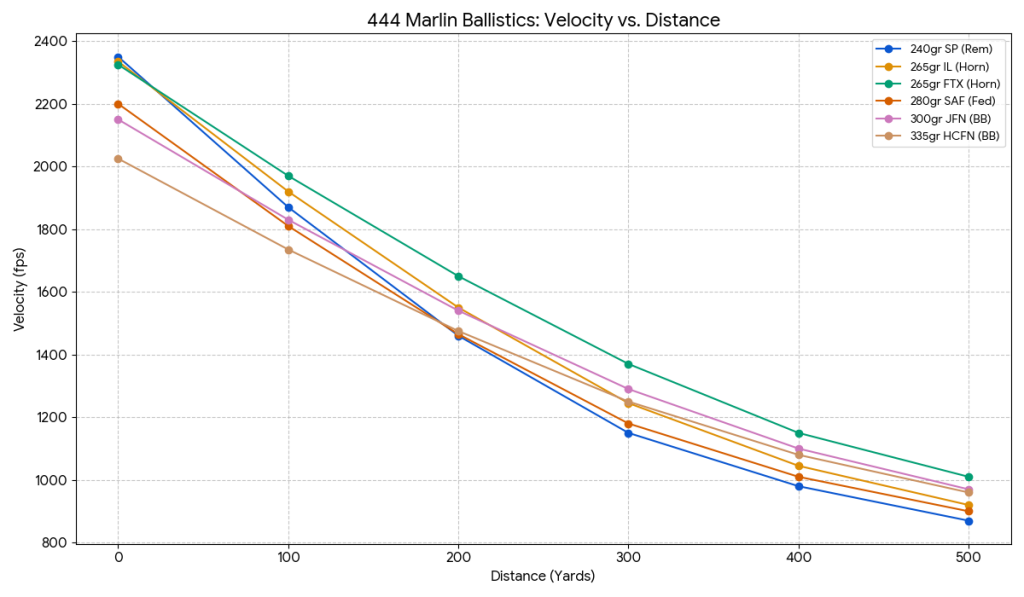
Below is a detailed ballistics table featuring the most popular and proven factory ammunition loads available today. The data represents a standard twenty-two-inch test barrel commonly found on traditional Marlin lever-action rifles and assumes a one hundred yard zero. Atmospheric conditions are based on standard sea-level metrics. Because this cartridge traditionally fires blunt, flat-nosed bullets, its aerodynamic efficiency drops off significantly past two hundred yards.
| Bullet Weight | Bullet Type | Manufacturer | Muzzle Velocity | Velocity At 100 Yards | Velocity At 200 Yards | Velocity At 300 Yards | Velocity At 400 Yards | Velocity At 500 Yards | Muzzle Energy | Energy At 100 Yards | Energy At 200 Yards | Energy At 300 Yards | Energy At 400 Yards | Energy At 500 Yards | Trajectory At 100 Yards | Trajectory At 200 Yards | Trajectory At 300 Yards | Trajectory At 400 Yards | Trajectory At 500 Yards | Ballistic Coefficient | Sectional Density |
| 240 Grain | Soft Point | Remington | 2350 fps | 1870 fps | 1460 fps | 1150 fps | 980 fps | 870 fps | 2942 ft lbs | 1863 ft lbs | 1135 ft lbs | 704 ft lbs | 512 ft lbs | 403 ft lbs | 0 inches | 8.5 inches drop | 35.0 inches drop | 90.0 inches drop | 180.0 inches drop | 0.165 | 0.185 |
| 265 Grain | InterLock FP | Hornady | 2335 fps | 1920 fps | 1550 fps | 1245 fps | 1045 fps | 920 fps | 3208 ft lbs | 2169 ft lbs | 1413 ft lbs | 912 ft lbs | 642 ft lbs | 498 ft lbs | 0 inches | 7.5 inches drop | 29.5 inches drop | 75.0 inches drop | 150.0 inches drop | 0.189 | 0.205 |
| 265 Grain | FTX LEVERevolution | Hornady | 2325 fps | 1970 fps | 1650 fps | 1370 fps | 1150 fps | 1010 fps | 3180 ft lbs | 2285 ft lbs | 1602 ft lbs | 1104 ft lbs | 778 ft lbs | 600 ft lbs | 0 inches | 6.5 inches drop | 26.0 inches drop | 65.0 inches drop | 130.0 inches drop | 0.225 | 0.205 |
| 280 Grain | Swift A-Frame | Federal Premium | 2200 fps | 1810 fps | 1465 fps | 1180 fps | 1010 fps | 900 fps | 3008 ft lbs | 2036 ft lbs | 1334 ft lbs | 866 ft lbs | 634 ft lbs | 503 ft lbs | 0 inches | 8.8 inches drop | 33.5 inches drop | 82.5 inches drop | 165.0 inches drop | 0.190 | 0.216 |
| 300 Grain | JFN Heavy | Buffalo Bore | 2150 fps | 1830 fps | 1540 fps | 1290 fps | 1100 fps | 970 fps | 3078 ft lbs | 2230 ft lbs | 1580 ft lbs | 1108 ft lbs | 806 ft lbs | 626 ft lbs | 0 inches | 8.0 inches drop | 30.0 inches drop | 75.0 inches drop | 145.0 inches drop | 0.245 | 0.232 |
| 335 Grain | Hard Cast Flat Nose | Buffalo Bore | 2025 fps | 1735 fps | 1475 fps | 1250 fps | 1080 fps | 960 fps | 3049 ft lbs | 2238 ft lbs | 1618 ft lbs | 1162 ft lbs | 868 ft lbs | 685 ft lbs | 0 inches | 9.5 inches drop | 34.0 inches drop | 82.0 inches drop | 158.0 inches drop | 0.260 | 0.259 |
Understanding The Chart
A ballistics chart can look overwhelming at first glance due to the sheer volume of data presented. Breaking down each individual column reveals key information about how a specific load performs in the field.
Muzzle Velocity
Muzzle velocity is the exact speed at which the bullet exits the barrel of the firearm. It is measured in feet per second (fps). The 444 Marlin generates highly impressive velocities for a straight-walled, big-bore cartridge. By utilizing a massive powder capacity, it pushes heavy .429-inch to .430-inch diameter bullets at speeds exceeding 2,300 fps. This high initial velocity allows the blunt bullets to fly surprisingly flat out to 150 yards before air resistance begins to severely degrade their forward momentum.
Retained Velocity
Retained velocity refers to the speed of the bullet at specific distances downrange, such as one hundred or five hundred yards. Because traditional lever-action rifles utilize tubular magazines, bullets are seated end-to-end. This historically required the use of blunt, flat-nosed bullets to prevent accidental primer detonation during recoil. These blunt bullets act like a parachute in the air, causing the 444 Marlin to shed its velocity extremely fast once it passes 200 yards.
Kinetic Energy
Kinetic energy is the amount of destructive physical force the bullet carries, measured in foot-pounds (ft-lbs). Hunters must pay close attention to this specific metric on a 444 Marlin Energy Chart to ensure they have enough power to ethically harvest massive game animals. The cartridge hits with spectacular authority, generating well over 3,000 ft-lbs of energy at the muzzle. Inside 150 yards, it possesses enough kinetic energy to completely break the shoulders of a massive moose or grizzly bear.
Trajectory
Trajectory indicates the actual physical path the bullet takes as it flies through the air, factoring in the constant downward pull of gravity. The trajectory chart displays the bullet drop in inches at various yardages relative to your line of sight. While it shoots impressively flat inside 150 yards, the heavy, blunt bullets experience an incredibly steep, mortar-like drop past 250 yards. Precise distance estimation is absolutely critical if attempting a shot beyond 200 yards.
Ballistic Coefficient
The Ballistic Coefficient (BC) is a numerical value that represents how efficiently a bullet cuts through the air. A higher number means the bullet is much more aerodynamic and will retain its velocity and energy far better over long distances. Traditional 444 Marlin flat-point bullets have exceptionally poor aerodynamic ratings. However, Hornady’s LEVERevolution ammunition utilizes a pliable polymer flex-tip, which allows for a more pointed, aerodynamic profile that remains completely safe in tubular magazines, slightly improving the BC.
Sectional Density
Sectional density is the ratio of a bullet weight compared directly to its diameter. A higher sectional density generally results in much deeper penetration into a target. Because the .429 diameter is quite wide, 240-grain bullets suffer from low sectional density and can fragment too quickly at high rifle velocities. Stepping up to 265-grain or 300-grain bullets drastically improves sectional density, ensuring the bullet penetrates deeply through thick muscle and heavy bone.
Common 444 Marlin Bullet Weights
Selecting the proper bullet weight is the single most critical decision a shooter can make for this specific caliber due to its unique history and internal ballistics.
240 Grain
When the cartridge was initially introduced, ammunition manufacturers loaded it with existing 240-grain pistol bullets designed for the .44 Magnum. However, driving these thin-jacketed pistol bullets at 2,350 fps caused them to over-expand and fragment violently upon impact, leading to poor penetration on large game. Today, modern 240-grain soft points are constructed with tougher jackets, making them highly effective for hunting whitetail deer and thin-skinned game where explosive energy transfer is desired.
265 Grain
The 265-grain bullet is the absolute gold standard for the 444 Marlin. Hornady specifically designed their 265-grain InterLock flat point explicitly for this cartridge to solve the penetration issues of the lighter 240-grain pistol bullets. The 265-grain weight provides a brilliant balance of high muzzle velocity, excellent structural integrity, and deep penetration. Whether in a traditional flat point or the modern polymer-tipped FTX design, this is the most versatile and proven weight available.
300 to 335 Grain
Heavyweight bullets ranging from 300 to 335 grains turn the 444 Marlin into an absolute brush-clearing juggernaut. Ammunition companies like Buffalo Bore utilize hard-cast lead flat-nose bullets in these weights. Because hard-cast lead does not expand, these massive projectiles utilize their heavy momentum to crush through solid bone in a perfectly straight line, making them the ultimate choice for dangerous game, heavy coastal brown bears, and giant wild hogs.
The Twist Rate Controversy: Micro-Groove vs. Ballard
Understanding the 444 Marlin requires understanding the rifling of the rifles chambered for it. For decades, Marlin utilized their famous “Micro-Groove” rifling with a highly sluggish 1-in-38-inch twist rate.
While this slow twist rate perfectly stabilized lightweight 240-grain and 265-grain bullets, it notoriously failed to stabilize heavy 300+ grain bullets, causing them to tumble in flight and destroy accuracy. Realizing that hunters wanted to use heavier bullets for dangerous game, Marlin eventually transitioned to deep-cut “Ballard” rifling with a much faster 1-in-20-inch twist rate in the late 1990s. If you plan to shoot massive 300+ grain hard-cast bullets, you must verify that your rifle features the faster 1-in-20 twist rate.
Effective Hunting Range
The 444 Marlin was engineered from the ground up to be a phenomenal close-quarters hunting cartridge. Knowing its strict capabilities ensures ethical hunting practices in the field.
Whitetail Deer and Black Bear
For whitetail deer and black bear, this cartridge is highly effective out to 200 yards. It delivers devastating hydrostatic shock and provides absolute knockdown power in dense woodland environments. A 265-grain bullet will easily anchor a massive black bear over bait with complete pass-through penetration.
Elk and Moose
Elk and moose are massive, heavily boned animals that require incredibly deep penetration. The 444 Marlin is an exceptional elk and moose cartridge when shots are kept inside 150 yards. Utilizing tough 265-grain or 300-grain bullets ensures the projectile can smash through the heavy shoulder bones and reach the vital organs perfectly.
Wild Hogs
Feral hogs are extremely tough creatures wrapped in a thick shield of cartilage. The classic fast-handling lever-action rifle paired with this heavy-hitting straight-walled cartridge is widely considered one of the absolute best combinations on earth for wild hog eradication in dense swamps.
Dangerous Game
When loaded with 300 to 335-grain hard-cast heavy loads, the 444 Marlin is frequently carried by guides and backcountry hikers in Alaska and Canada for defense against grizzly and brown bears. The heavy, non-expanding flat meplat crushes tissue and breaks heavy skeletal structures reliably at close quarters.
Best Zero Distance
Selecting the optimal zero distance depends entirely on how you plan to use your firearm in the field.
50 Yard Zero
A 50-yard zero is highly practical for hunters operating in extremely dense timber where long shots are physically impossible. It keeps the heavy bullet trajectory incredibly tight to your iron sights or low-power optic, making it the perfect setup for hunting bears over bait or pushing wild hogs out of thick brush.
100 Yard Zero
The 100-yard zero is the absolute gold standard for this cartridge. Factory ballistics data is almost exclusively calculated using this specific distance. It provides a clean, perfect mathematical baseline, allowing the shooter to understand the severe bullet drop that occurs once the heavy bullet travels past 150 yards.
150 Yard Zero
A 150-yard zero is an excellent Maximum Point Blank Range (MPBR) strategy if you are utilizing the modern Hornady LEVERevolution polymer-tipped ammunition. By zeroing at 150 yards, the bullet will strike roughly 1.5 to 2 inches high at 100 yards and drop about 4 inches at 200 yards, allowing you to hold dead-center on a deer’s chest out to 200 yards without calculating holdovers.
444 Marlin Ballistics Compared To Other Cartridges
To truly appreciate the brilliant engineering behind this big-bore cartridge, we must compare it directly against its closest competitors in the lever-action world.
| Cartridge | Muzzle Velocity | Muzzle Energy | Trajectory At 200 Yards | Recoil | Effective Range | Receiver Platform |
| 444 Marlin (265gr) | 2335 fps | 3208 ft lbs | 7.5 inches drop | Heavy | 200 Yards | Standard Lever Action |
| 45-70 Govt (300gr) | 1880 fps | 2354 ft lbs | 8.5 inches drop | Heavy | 200 Yards | Standard Lever Action |
| 44 Remington Mag (240gr) | 1760 fps | 1650 ft lbs | 16.5 inches drop | Moderate | 100 Yards | Standard Lever Action |
| 450 Marlin (325gr) | 2225 fps | 3572 ft lbs | 7.8 inches drop | Very Heavy | 200 Yards | Standard Lever Action |
| 30-30 Winchester (170gr) | 2200 fps | 1827 ft lbs | 9.5 inches drop | Light | 200 Yards | Standard Lever Action |
When comparing the 444 Marlin to the legendary 45-70 Government, the differences lie in velocity and bullet diameter. The 444 Marlin utilizes a slightly narrower bullet (.429 vs .458) but pushes it significantly faster than standard-pressure 45-70 loads. This gives the 444 Marlin a slightly flatter trajectory inside 200 yards. However, the massive case capacity of the 45-70 allows it to be hand-loaded with 400+ grain bullets, something the 444 Marlin cannot match.
Against the .44 Magnum fired from a rifle, the 444 Marlin completely dominates. While both fire the exact same diameter bullet, the 444 Marlin holds vastly more powder. It generates nearly double the kinetic energy and completely outclasses the pistol cartridge in every single hunting metric.
When stacked against the heavy 450 Marlin, the 444 produces slightly less kinetic energy and noticeably less punishing recoil, making it slightly more pleasant to shoot during long range sessions while still delivering devastating terminal performance.
Frequently Asked Questions
What is a 444 Marlin Ballistics Chart?
It is a highly comprehensive reference table that tracks the velocity, kinetic energy, and trajectory curve of the cartridge over various distances. Shooters heavily rely on this specific data to precisely calculate exactly how much their heavy bullet will drop, allowing for accurate elevation adjustments during woodland hunting engagements.
Can the 444 Marlin accurately reach 300 yards?
While it is mathematically possible to hit a target at 300 yards, it is absolutely not recommended for practical or reliable hunting applications. The heavy, blunt bullets lack the aerodynamic efficiency required to reach 300 yards without extreme bullet drop (often dropping over two feet). Attempting to shoot game animals at 300 yards invites tragedy due to massive velocity loss and wind drift.
Does the 444 Marlin have heavy recoil?
Yes. Because it burns a large powder charge to push massive bullets at over 2,300 fps, it generates heavy recoil. While not quite as brutal as high-pressure 45-70 loads or heavy magnum rifles, it will produce a sharp, heavy shove that requires proper shooting fundamentals to manage effectively.
Is the 444 Marlin good for grizzly bears?
Yes, it is highly respected as a dangerous game defense cartridge when loaded with heavy 300-grain to 335-grain hard-cast lead bullets. These specialized, non-expanding loads will penetrate deeply through the thick muscle and heavy skull of a grizzly bear at close ranges.
What is the best bullet weight for deer hunting?
The absolute best bullet weight for general deer hunting falls exclusively on the 265-grain standard. Whether using the traditional Hornady InterLock flat point or the modern FTX polymer tip, the 265-grain bullet offers a brilliant balance of high muzzle velocity, reliable feeding, and rapid violent expansion without sacrificing penetration.
Conclusion
Understanding a 444 Marlin Ballistics Chart is absolutely essential for any shooter who wants to extract the absolute maximum performance from this incredibly massive and fascinating woodland hunting cartridge. By studying the energy charts, analyzing the trajectory curves, and understanding the critical history of its rifling twist rates, you can ensure that you select the perfect ammunition for your specific rifle. The numbers clearly demonstrate exactly why this phenomenal big-bore cartridge has maintained a fiercely loyal following among American hunters who demand maximum stopping power in the deep woods.
By thoroughly mastering your data and selecting the optimal zero distance, you eliminate all guesswork from your shooting routine entirely. The effective range of this cartridge is strictly limited by physics, making it the perfect heavy-hitting tool for heavy timber brush hunting. With massive knockdown power, flawless lever-action reliability, and absolutely devastating terminal performance on massive game, the 444 Marlin continues to prove that it is one of the absolute greatest brush-clearing rifle cartridges ever designed.