The main difference between the 270 WSM and the 270 Win is their case design and resulting action length. The 270 Winchester is a traditional standard length cartridge based on the modified 30 03 Springfield case, while the 270 Winchester Short Magnum features a short and fat case designed specifically to fit into lightweight short action rifles. Because of its wider powder column and more efficient ignition, the 270 WSM produces roughly 100 to 150 feet per second more muzzle velocity than the standard 270 Win when firing the exact same 130 grain bullet. This velocity advantage translates into slightly more kinetic energy and a marginally flatter trajectory at long range. However, the original 270 Win remains vastly more popular today, offering significantly cheaper ammunition, lower felt recoil, and virtually identical hunting performance on deer sized game inside 400 yards.
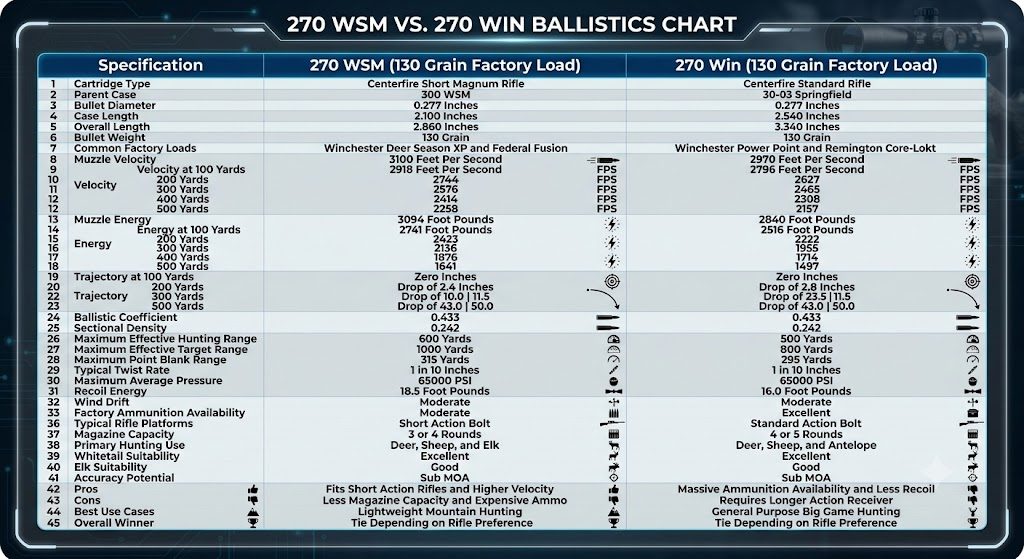
270 WSM vs 270 Win Ballistics Chart
| Specification | 270 WSM (130 Grain Factory Load) | 270 Win (130 Grain Factory Load) |
| Cartridge Type | Centerfire Short Magnum Rifle | Centerfire Standard Rifle |
| Parent Case | 300 WSM | 30 03 Springfield |
| Bullet Diameter | 0.277 Inches | 0.277 Inches |
| Case Length | 2.100 Inches | 2.540 Inches |
| Overall Length | 2.860 Inches | 3.340 Inches |
| Bullet Weight | 130 Grain | 130 Grain |
| Common Factory Loads | Winchester Deer Season XP and Federal Fusion | Winchester Power Point and Remington Core Lokt |
| Muzzle Velocity | 3100 Feet Per Second | 2970 Feet Per Second |
| Muzzle Energy | 3094 Foot Pounds | 2840 Foot Pounds |
| Velocity at 100 Yards | 2918 Feet Per Second | 2796 Feet Per Second |
| Velocity at 200 Yards | 2744 Feet Per Second | 2627 Feet Per Second |
| Velocity at 300 Yards | 2576 Feet Per Second | 2465 Feet Per Second |
| Velocity at 400 Yards | 2414 Feet Per Second | 2308 Feet Per Second |
| Velocity at 500 Yards | 2258 Feet Per Second | 2157 Feet Per Second |
| Energy at 100 Yards | 2741 Foot Pounds | 2516 Foot Pounds |
| Energy at 200 Yards | 2423 Foot Pounds | 2222 Foot Pounds |
| Energy at 300 Yards | 2136 Foot Pounds | 1955 Foot Pounds |
| Energy at 400 Yards | 1876 Foot Pounds | 1714 Foot Pounds |
| Energy at 500 Yards | 1641 Foot Pounds | 1497 Foot Pounds |
| Trajectory at 100 Yards | Zero Inches | Zero Inches |
| Trajectory at 200 Yards | Drop of 2.4 Inches | Drop of 2.8 Inches |
| Trajectory at 300 Yards | Drop of 10.0 Inches | Drop of 11.5 Inches |
| Trajectory at 400 Yards | Drop of 23.5 Inches | Drop of 27.0 Inches |
| Trajectory at 500 Yards | Drop of 43.0 Inches | Drop of 50.0 Inches |
| Ballistic Coefficient | 0.433 | 0.433 |
| Sectional Density | 0.242 | 0.242 |
| Maximum Effective Hunting Range | 600 Yards | 500 Yards |
| Maximum Effective Target Range | 1000 Yards | 800 Yards |
| Maximum Point Blank Range | 315 Yards | 295 Yards |
| Typical Twist Rate | 1 in 10 Inches | 1 in 10 Inches |
| Maximum Average Pressure | 65000 PSI | 65000 PSI |
| Recoil Energy | 18.5 Foot Pounds | 16.0 Foot Pounds |
| Wind Drift | Moderate | Moderate |
| Factory Ammunition Availability | Moderate | Excellent |
| Typical Rifle Platforms | Short Action Bolt | Standard Action Bolt |
| Magazine Capacity | 3 or 4 Rounds | 4 or 5 Rounds |
| Primary Hunting Use | Deer Sheep and Elk | Deer Sheep and Antelope |
| Whitetail Suitability | Excellent | Excellent |
| Elk Suitability | Good | Good |
| Accuracy Potential | Sub MOA | Sub MOA |
| Pros | Fits Short Action Rifles and Higher Velocity | Massive Ammunition Availability and Less Recoil |
| Cons | Less Magazine Capacity and Expensive Ammo | Requires Longer Action Receiver |
| Best Use Cases | Lightweight Mountain Hunting | General Purpose Big Game Hunting |
| Overall Winner | Tie Depending on Rifle Preference | Tie Depending on Rifle Preference |
Muzzle Velocity Comparison
The 270 WSM was specifically engineered to outperform the venerable 270 Win in the velocity department. A typical 130 grain bullet leaves the 270 WSM barrel at roughly 3100 feet per second. The older standard cartridge pushes the exact same bullet at 2970 feet per second. This 130 feet per second advantage is achieved through a shorter and wider powder column that promotes faster and more efficient burning characteristics before the bullet leaves the muzzle.
Muzzle Energy Comparison
More velocity with the same bullet weight naturally yields higher kinetic energy. The 270 WSM generates 3094 foot pounds of energy at the muzzle compared to the 2840 foot pounds produced by the 270 Win. Out at 500 yards the short magnum retains 1641 foot pounds of energy while the standard cartridge drops to 1497 foot pounds. Both rounds deliver plenty of knockdown power for deer sized game but the short magnum gives hunters a slight edge when stretching shots across wide open canyons.
Trajectory Comparison
Both cartridges are famous for being incredibly flat shooting over typical hunting distances. When zeroed at 100 yards the 270 WSM drops exactly 10 inches at 300 yards. The standard 270 Win drops 11.5 inches at that same distance. The trajectory difference becomes slightly more noticeable at 500 yards where the 270 WSM drops 43 inches compared to the 50 inches of drop from the standard cartridge. For hunters shooting inside 300 yards this slight ballistic advantage is practically indistinguishable in the field.
Recoil Comparison
Pushing a bullet faster requires more powder and consequently generates more felt recoil. The 270 WSM produces roughly 18.5 foot pounds of recoil energy depending on the exact rifle weight. The traditional 270 Win produces a milder 16 foot pounds of recoil. Since short magnum rifles are often built lighter for mountain hunting this difference in recoil can feel even more pronounced on the shooter’s shoulder during long range practice sessions.
Rifle Action Length Comparison
The defining physical difference between these two cartridges is the rifle action required to cycle them. The 270 Win has a long overall length of 3.340 inches which mandates a standard long action receiver. The 270 WSM was designed with an overall length of 2.860 inches to fit perfectly into short action receivers. A short action rifle is generally lighter, features a shorter bolt throw for faster follow up shots, and is much easier to carry up steep mountainsides.
Ammunition Availability Comparison
The 270 Win is one of the most beloved hunting cartridges in American history and enjoys universal ammunition availability. You can find boxes of 270 Win in almost any hardware store or sporting goods shop globally. The 270 WSM peaked in popularity during the early 2000s but has since seen a decline in factory load options. While you can certainly still find short magnum ammunition it is typically much more expensive and comes with fewer bullet weight choices than the standard cartridge.
Which Cartridge Is Better for Deer Hunting
For 90 percent of whitetail deer hunters the classic 270 Win is the better overall choice. It offers milder recoil, cheaper practice ammunition, and devastating terminal performance at normal hunting distances. However if you hunt mule deer in rugged western states where saving weight is critical, a lightweight short action rifle chambered in 270 WSM provides the perfect combination of portability and extended range reach.
Frequently Asked Questions
Can I shoot 270 Win ammunition in a 270 WSM rifle?
You absolutely cannot interchange these two cartridges. The 270 WSM uses a dramatically wider case design that will not chamber correctly in a standard rifle. Attempting to fire the wrong ammunition in either firearm could result in catastrophic failure and serious personal injury.
Is the 270 WSM barrel life shorter than the 270 Win?
Yes the 270 WSM generally exhibits a shorter barrel life than the standard cartridge. The short magnum burns a larger charge of powder in a shorter space which accelerates throat erosion just in front of the chamber. However most big game hunters will never shoot enough rounds in their lifetime to completely wear out a hunting rifle barrel.
Why did the 270 WSM become so popular?
It became highly popular because it delivered magnum level performance in a compact short action rifle. Hunters loved the idea of carrying a lightweight rifle that could shoot flatter and hit harder than the classic 270 Win. The short bolt throw also allowed for slightly faster cycling when follow up shots were required.
What is the best bullet weight for a 270 Winchester?
The 130 grain bullet is historically considered the absolute best choice for both of these cartridges when hunting deer sized game. It offers the perfect balance of high velocity, flat trajectory, and reliable terminal expansion. For larger game like elk or moose many hunters prefer stepping up to heavier 140 or 150 grain projectiles for deeper penetration.
Can a 270 Win take down a moose?
Yes the standard 270 Win is fully capable of taking down a moose when loaded with premium heavy bullets and placed accurately into the vital organs. Legendary gun writers successfully hunted large game all over the world with this cartridge for decades. You should select a high quality 150 grain bonded or solid copper bullet to ensure deep penetration through heavy bone and muscle.
Does a short action rifle really make a difference?
A short action rifle saves roughly half a pound of weight and reduces the bolt travel distance by about half an inch compared to a standard action. While this seems trivial on paper it makes a noticeable difference in handling characteristics and carry comfort during long backcountry hikes. Competitive shooters also favor short actions because the stiffer receiver often yields slightly better inherent accuracy.
Why does the 270 WSM hold fewer rounds in the magazine?
The short magnum case is significantly wider than a standard cartridge case. This extra girth means fewer rounds can physically fit inside a standard internal box magazine. Most short action rifles chambered in 270 WSM will hold only three rounds internally while a standard rifle chambered in 270 Win can comfortably hold four or five rounds.