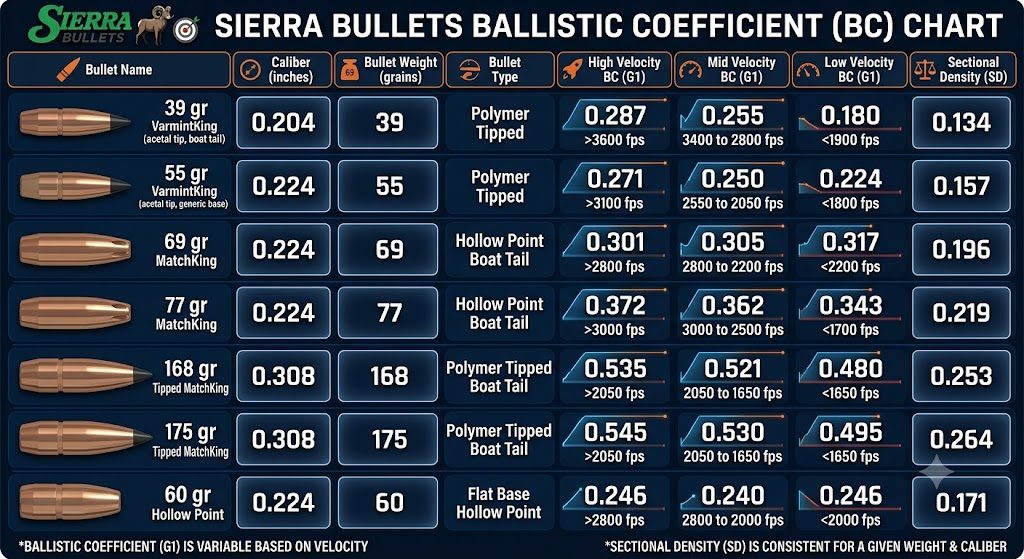
The sierra bullets bc chart provides a comprehensive breakdown of the aerodynamic efficiency of various Sierra projectiles, specifically detailing how their Ballistic Coefficient changes across different velocity bands. Sierra is unique among ammunition manufacturers because they publish multiple G1 ballistic coefficients for a single bullet based on its flight speed, recognizing that a bullet’s drag profile shifts as it slows down. Below, you will find a detailed table featuring some of Sierra’s most popular MatchKing, BlitzKing, and GameKing bullets, complete with their sectional densities and specific G1 BC ratings at high, medium, and low velocities. This data allows precision shooters and reloaders to calculate highly accurate drop charts by inputting the correct BC for the exact velocity their bullet will be traveling at specific distances.
Sierra Bullets BC Chart
| Bullet Name | Caliber (inches) | Bullet Weight (grains) | Bullet Type | High Velocity BC (G1) | Mid Velocity BC (G1) | Low Velocity BC (G1) | Sectional Density (SD) |
| 39 gr BlitzKing | 0.204 | 39 | Polymer Tipped | 0.287 (>3600 fps) | 0.255 (3400 to 2800 fps) | 0.180 (<1900 fps) | 0.134 |
| 55 gr BlitzKing | 0.224 | 55 | Polymer Tipped | 0.271 (>3100 fps) | 0.250 (2550 to 2050 fps) | 0.224 (<1800 fps) | 0.157 |
| 69 gr MatchKing | 0.224 | 69 | Hollow Point Boat Tail | 0.301 (>2800 fps) | 0.305 (2800 to 2200 fps) | 0.317 (<2200 fps) | 0.196 |
| 77 gr MatchKing | 0.224 | 77 | Hollow Point Boat Tail | 0.372 (>3000 fps) | 0.362 (3000 to 2500 fps) | 0.343 (<1700 fps) | 0.219 |
| 168 gr Tipped MatchKing | 0.308 | 168 | Polymer Tipped Boat Tail | 0.535 (>2050 fps) | 0.521 (2050 to 1650 fps) | 0.480 (<1650 fps) | 0.253 |
| 175 gr Tipped MatchKing | 0.308 | 175 | Polymer Tipped Boat Tail | 0.545 (>2050 fps) | 0.530 (2050 to 1650 fps) | 0.495 (<1650 fps) | 0.264 |
| 60 gr Hollow Point | 0.224 | 60 | Flat Base Hollow Point | 0.246 (>2800 fps) | 0.240 (2800 to 2000 fps) | 0.246 (<2000 fps) | 0.171 |
Understanding the Chart
Bullet Name
The bullet name identifies the specific product line within Sierra’s catalog. This matters because each family of bullets is engineered for a completely different purpose. For example, MatchKing bullets are built with incredibly thin jackets and tiny hollow points to prioritize extreme accuracy and high ballistic coefficients for target shooting. Conversely, BlitzKing bullets are designed with polymer tips and thin jackets for explosive expansion on small varmints. Interpreting this column ensures you select a projectile designed for your specific application. A common mistake is using MatchKing bullets for big game hunting, which is strongly discouraged by Sierra because they are not designed for controlled expansion on heavy tissue.
Caliber (inches)
This metric represents the actual physical diameter of the bullet measured in inches. It is crucial because you must match the exact bullet diameter to the bore of your rifle for safety and accuracy. When interpreting this data, understand that a .308 caliber bullet is the standard size for cartridges like the .308 Winchester, .30-06 Springfield, and .300 Winchester Magnum, while .224 is standard for the 5.56 NATO and .223 Remington. Real-world performance relies on this precise measurement to ensure the bullet seals the bore correctly to generate optimal velocity. Reloaders must never mistake similar-sounding calibers, such as loading a .311 caliber bullet into a .308 caliber bore, as this can cause catastrophic pressure spikes.
Bullet Weight (grains)
Bullet weight is measured in grains, a standard unit in the firearms industry where one ounce equals roughly 437.5 grains. This column is important because weight directly influences a bullet’s velocity, recoil, and ability to resist wind deflection. You can interpret this metric by recognizing that heavier bullets within the same caliber generally offer higher ballistic coefficients and deeper penetration, but they leave the muzzle at slower speeds. In the field, a 77-grain bullet in a .223 Remington will buck the wind much better at 500 yards than a 55-grain bullet. A common misconception is that you can freely swap bullet weights without changing your powder charge, which is extremely dangerous in handloading.
Bullet Type
Bullet type describes the physical shape and construction of the projectile. This matters immensely because aerodynamic drag is largely dictated by the bullet’s nose profile (ogive) and its base. When reading this column, look for terms like Hollow Point Boat Tail (HPBT), which features a tapered rear to reduce base drag, or Polymer Tipped, which improves the aerodynamic flow over the nose. In practice, a boat tail design retains velocity significantly better at extreme ranges compared to a flat base bullet. Shooters often make the mistake of assuming all hollow points are designed to expand, but in target bullets like the MatchKing, the hollow point is simply a byproduct of the manufacturing process used to create a perfectly balanced core.
High Velocity BC (G1)
The High Velocity BC is the G1 Ballistic Coefficient applied when the bullet is traveling at its fastest speeds, typically right after leaving the muzzle. This number is critical for calculating trajectory during the first few hundred yards of flight. To interpret this column, you must look at the velocity threshold provided; if your muzzle velocity is 3,200 feet per second, you will use this BC until the bullet slows down to the next tier. In real-world shooting, this BC is what most manufacturers print on the box, as it is usually the highest and most impressive number. However, relying solely on this high-speed BC for a 1,000-yard shot is a massive mistake, as your drop calculations will be completely incorrect once the bullet slows down.
Mid Velocity BC (G1)
The Mid Velocity BC applies to the bullet as it sheds speed and enters a moderate velocity band. This metric is incredibly important because the drag profile of a bullet changes as it transitions away from its peak supersonic speed. Interpreting this data requires you to use a ballistic calculator that allows for stepped or multiple BC inputs, shifting to this number once the bullet crosses the upper velocity threshold. In the field, using the correct mid-velocity BC ensures your holdovers are perfectly precise at medium ranges like 400 to 600 yards. A fascinating quirk found in some blunt or hollow-point Sierra bullets is that their BC might actually increase slightly at medium velocities compared to high velocities, due to how their specific shape interacts with drag algorithms.
Low Velocity BC (G1)
The Low Velocity BC is the aerodynamic rating used when the bullet has slowed significantly, often as it approaches the transonic zone (around 1,200 to 1,400 fps). This metric matters for extreme long-range shooters who are pushing their cartridges to the absolute limit. You interpret this column by applying it to the final stages of your bullet’s flight path in your ballistics app. In a real-world scenario, failing to account for a drastically lower BC at low velocities will result in the bullet dropping much faster and getting pushed by the wind much harder than expected. Many shooters mistakenly blame their rifle or optic for missing targets at 800 yards, when the real culprit is a ballistic calculator that was never programmed with the bullet’s lower BC at that distance.
Sectional Density (SD)
Sectional density is the mathematical ratio of the bullet’s weight relative to its diameter. This measurement is deeply important for predicting how well a projectile will penetrate a target. Interpreting this column is straightforward: the higher the sectional density number, the better the bullet can drive through resistance. While this is primarily a hunting metric to ensure ethical harvests, it also plays a role in target shooting by helping maintain momentum. A common mistake is comparing the sectional density of two different calibers based on weight alone; a 150-grain .270 caliber bullet has a much higher sectional density than a 150-grain .308 caliber bullet because the mass is concentrated behind a narrower frontal area.
If you are looking to see how some of these bullets perform in real-world testing, you can watch this 77gr Sierra MatchKing testing overview. It provides a great look at the velocity consistency and accuracy you can achieve with these specific high-BC projectiles in a custom setup.