For generations, hunters seeking a reliable, hard-hitting lever-action cartridge for dense timber have consulted a 35 remington ballistics chart. This chart outlines the flight path, muzzle velocity, retained energy, and bullet drop for one of the most iconic brush guns in American history. Designed in 1906, the .35 Remington pushes heavy, wide-diameter bullets that punch through heavy cover and deliver devastating terminal performance on deer, black bear, and wild hogs. In this article, you will find a highly detailed, research-backed breakdown of factory .35 Remington ammunition ballistics, followed by an in-depth guide on how to interpret each metric for your next hunt. Please note that data can vary depending on your specific firearm, particularly barrel length, as most factory charts use 24-inch test barrels while most hunters carry 20-inch lever-action carbines.
35 Remington Ballistics Chart
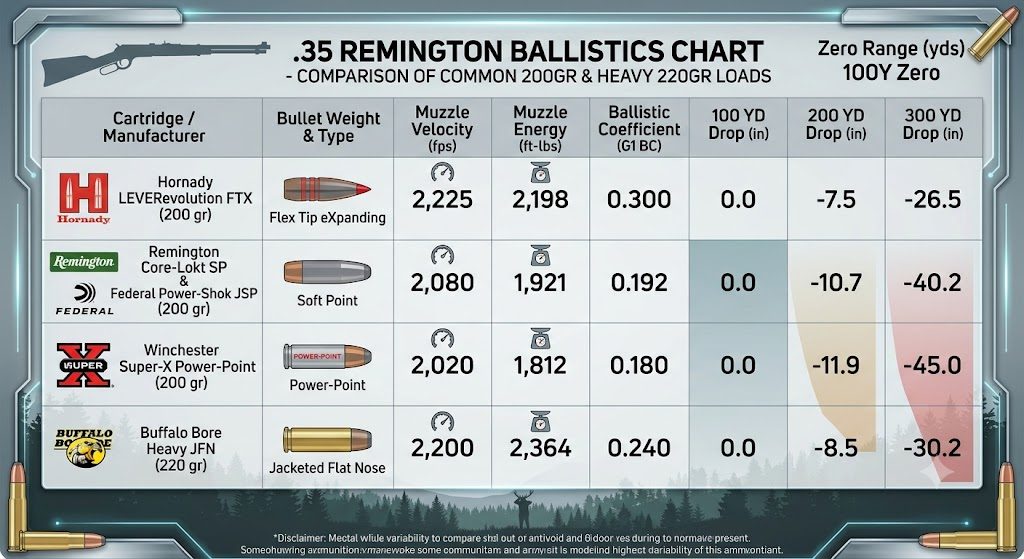
The following trajectory data reflects standard factory specifications tested under controlled atmospheric conditions. Because the .35 Remington is primarily a brush cartridge used at shorter distances, the trajectory data here assumes a 100-yard zero.
| Cartridge | Bullet Weight & Manufacturer | Muzzle Velocity (fps) | Muzzle Energy (ft-lbs) | Ballistic Coefficient (G1) | 100 YD Drop (in) | 200 YD Drop (in) | 300 YD Drop (in) | Zero Range (yds) |
| .35 Remington | 200 gr Hornady LEVERevolution FTX | 2,225 | 2,198 | 0.300 | 0.0 | -7.5 | -26.5 | 100 |
| .35 Remington | 200 gr Remington Core-Lokt SP | 2,080 | 1,921 | 0.192 | 0.0 | -10.7 | -40.2 | 100 |
| .35 Remington | 200 gr Federal Power-Shok JSP | 2,080 | 1,921 | 0.192 | 0.0 | -10.7 | -40.2 | 100 |
| .35 Remington | 200 gr Winchester Super-X Power-Point | 2,020 | 1,812 | 0.180 | 0.0 | -11.9 | -45.0 | 100 |
| .35 Remington | 220 gr Buffalo Bore Heavy JFN | 2,200 | 2,364 | 0.240 | 0.0 | -8.5 | -30.2 | 100 |
Understanding the Chart
To maximize your success in the field, you must understand exactly what the numbers on a ballistics chart mean. Below is a comprehensive breakdown of every column included in the table above.
Cartridge
What it means: This column identifies the specific chambering of the firearm, which in this case is the .35 Remington.
Why it matters: Ammunition must be matched perfectly to the firearm’s chamber. The cartridge dimensions dictate case capacity, safe pressure limits (which is a moderate 33,500 CUP for the .35 Remington), and overall ballistic capabilities.
How to interpret it: Use this column simply to verify you are looking at the correct ammunition data.
Real-world performance: The .35 Remington is famous for its wide frontal area. By firing a .358-inch diameter bullet, it creates a much larger permanent wound channel than smaller calibers like the .30-30 Winchester, making it highly effective on tough, heavy-boned game in the woods.
Common mistakes: A frequent mistake is confusing the .35 Remington with other .35-caliber cartridges like the .35 Whelen or .350 Legend. These cartridges are not interchangeable and have vastly different pressure levels and performance profiles.
Bullet Weight & Manufacturer
What it means: This denotes the mass of the projectile measured in grains (gr), the manufacturer, and the specific bullet design (such as SP for Soft Point or FTX for Flex Tip eXpanding).
Why it matters: Bullet weight and construction directly impact velocity, wind resistance, and terminal energy. Traditional tubular magazine lever-action rifles require flat-nose or round-nose bullets (like the Core-Lokt or Power-Shok) to prevent accidental chain-fire in the magazine. Hornady solved this aerodynamic limitation by using a soft polymer tip on their FTX line.
How to interpret it: The 200-grain bullet is the undisputed gold standard for this cartridge, balancing recoil, velocity, and penetration perfectly.
Real-world performance: Traditional soft points like the Remington Core-Lokt act like a flying sledgehammer, expanding reliably at moderate velocities. The Hornady LEVERevolution FTX, however, uses its pointed polymer tip to fly faster and flatter while remaining perfectly safe to load in a tubular magazine.
Common mistakes: Assuming all 200-grain bullets fly the same. As the chart shows, a modern pointed bullet (FTX) performs drastically differently at distance than a traditional flat-nosed bullet.
Muzzle Velocity (fps)
What it means: Muzzle velocity is the speed of the bullet at the exact moment it exits the rifle’s barrel, measured in feet per second (fps).
Why it matters: Velocity dictates how flat a bullet will shoot and how hard it will hit the target.
How to interpret it: Higher numbers mean a faster-traveling bullet. The .35 Remington is intentionally designed for moderate velocities, typically hovering right around 2,000 to 2,200 fps.
Real-world performance: While 2,080 fps might seem slow compared to modern magnum rifles, this moderate velocity is exactly what makes the .35 Remington so effective. It prevents the bullet from fragmenting upon impact, ensuring deep, straight-line penetration on game without destroying excessive amounts of edible meat.
Common mistakes: Expecting the exact velocity printed on the box in the field. The muzzle velocity on a factory chart is generated using an industry-standard 24-inch test barrel. If you shoot a fast-handling 20-inch Marlin 336 carbine, your actual muzzle velocity will be roughly 50 to 100 fps slower.
Muzzle Energy (ft-lbs)
What it means: Muzzle energy measures the kinetic power of the bullet as it leaves the barrel, expressed in foot-pounds (ft-lbs).
Why it matters: Energy is a primary indicator of a cartridge’s stopping power, calculated using the bullet’s weight and velocity.
How to interpret it: The .35 Remington produces roughly 1,900 to 2,300 ft-lbs of energy at the muzzle. This gives it a roughly 15 to 20 percent power advantage over the .30-30 Winchester.
Real-world performance: This level of energy is devastating inside of 150 yards. It possesses more than enough kinetic energy to completely pass through the shoulders of large black bears or heavy wild boars.
Common mistakes: Relying strictly on muzzle energy for hunting calculations. Because these bullets have poor aerodynamics, they bleed energy very rapidly. A bullet leaving the barrel with 1,921 ft-lbs might only have 1,000 ft-lbs remaining at 150 yards.
Ballistic Coefficient (G1)
What it means: The Ballistic Coefficient (BC) is a mathematical value that represents a bullet’s aerodynamic efficiency.
Why it matters: A bullet with a high BC slices through the air efficiently, retaining its velocity longer and dropping less over distance.
How to interpret it: Values like 0.180 or 0.192 are quite low, reflecting the blunt, flat-nosed shapes required for lever-action rifles. The Hornady FTX achieves a much higher 0.300 BC thanks to its flexible pointed tip.
Real-world performance: Inside of 100 yards, a low BC makes zero difference in a hunting scenario. However, if you plan to stretch your shots past 150 yards, the higher BC of the Hornady LEVERevolution or Buffalo Bore rounds will provide noticeably better trajectory and wind resistance.
Common mistakes: Obsessing over BC for a brush gun. If you are hunting in thick swamps or dense timber where visibility maxes out at 75 yards, aerodynamic efficiency is practically irrelevant.
100 YD Drop (in)
What it means: This shows where the bullet impacts relative to the shooter’s line of sight at a distance of 100 yards, measured in inches.
Why it matters: This measurement confirms the rifle’s zero and serves as the baseline for the rest of the trajectory.
How to interpret it: Every value in this column is 0.0 because the ballistic data is built around a 100-yard zero. At exactly 100 yards, the bullet will strike the exact center of the crosshairs.
Real-world performance: A 100-yard zero is perfectly matched to the capabilities of the .35 Remington. It allows the hunter to hold dead center on a deer’s vital zone from the muzzle out to about 125 yards without needing to adjust aim.
Common mistakes: Sighting a .35 Remington in at 50 yards and assuming it will still hit dead center at 100 yards. Always confirm your zero at the actual distance you plan to hunt.
200 YD Drop (in)
What it means: This dictates how far below the center of the crosshairs the bullet will strike at exactly 200 yards.
Why it matters: This metric reveals the functional limits of traditional brush cartridges.
How to interpret it: Negative values (such as -10.7 inches) indicate that the bullet is falling rapidly. You must aim exactly 10.7 inches above your desired impact point to hit the target.
Real-world performance: 200 yards is generally considered the maximum ethical range for a standard .35 Remington soft point. To make a clean hit at this distance, you must hold the crosshairs near the very top of the animal’s back to allow the bullet to drop into the vital zone.
Common mistakes: Taking a 200-yard shot in the field without ever practicing holdovers on a paper target. The steep, rainbow-like trajectory of this cartridge requires absolute precision if you shoot past 150 yards.
300 YD Drop (in)
What it means: This indicates the bullet’s total vertical drop in inches at a distance of 300 yards.
Why it matters: 300-yard data perfectly illustrates why the .35 Remington is considered a short-range woodland cartridge rather than an open-plains sniper round.
How to interpret it: The extreme negative numbers (from -26.5 to -45.0 inches) show a trajectory that is plummeting toward the earth.
Real-world performance: The .35 Remington is not suitable for 300-yard hunting. Not only is the bullet dropping nearly four feet, but it has also lost so much velocity that traditional soft points will fail to expand, resulting in poor terminal performance and wounded game.
Common mistakes: Attempting to force a brush gun into a long-range role. If your hunting location frequently requires shots across 300-yard clearcuts or agricultural fields, you should switch to a different cartridge entirely.
Zero Range (yds)
What it means: The exact distance at which the rifle’s sights are calibrated so that the point of aim perfectly matches the bullet’s point of impact.
Why it matters: The chosen zero range anchors the entire arc of the trajectory chart. All drop data is mathematically dependent on this specific distance.
How to interpret it: In this chart, the zero range is set to 100 yards, which is the industry standard for traditional, flat-nosed lever-action calibers.
Real-world performance: Because the .35 Remington is relatively slow, a 100-yard zero keeps the bullet’s mid-range flight path very tight to the line of sight. It will hit slightly high at 50 yards and exactly on target at 100 yards.
Common mistakes: Attempting to use a 200-yard zero like you would with a modern high-velocity cartridge. If you zero a traditional 200-grain Core-Lokt at 200 yards, the bullet will strike nearly five inches high at 100 yards, which can easily result in shooting directly over the back of a deer in the thick timber. Keep the zero at 100 yards and embrace the cartridge for what it is: a legendary close-range powerhouse.