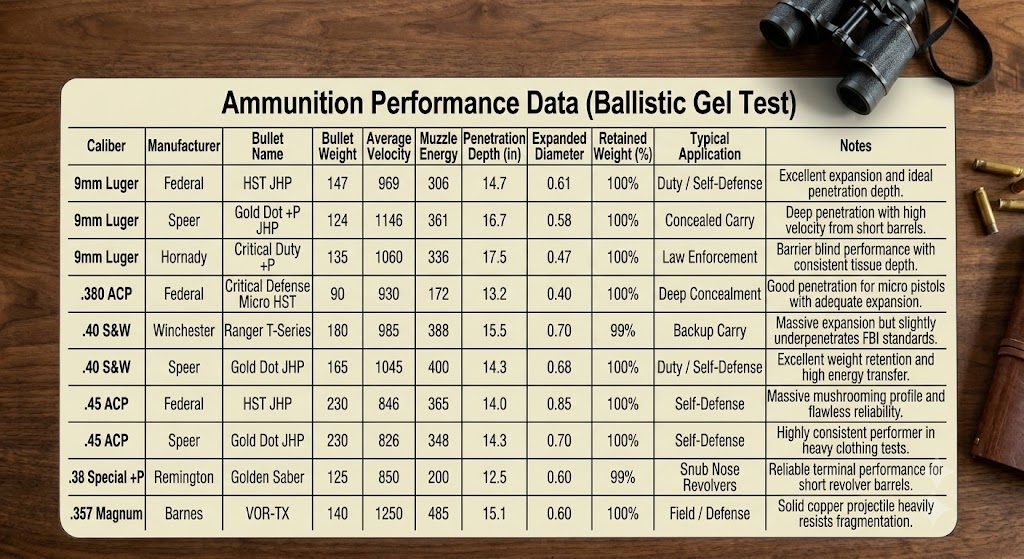
When shooters need to evaluate self-defense ammunition, the lucky gunner ballistics chart is widely considered the ultimate resource for comparing terminal performance. This extensive dataset answers the critical question of which handgun loads perform best when fired into synthetic gelatin covered by a heavy clothing barrier. In this comprehensive guide, you will find a detailed breakdown of top-performing cartridges based on this established testing protocol, covering vital metrics like penetration depths, expansion diameters, and retained bullet weights. It is important to note that performance heavily depends on variables such as barrel length, ammunition design, and environmental testing conditions. The figures provided in this article reflect data gathered using compact and subcompact test firearms typically carried for personal protection, ensuring the data is highly relevant for practical concealed carry applications.
Lucky Gunner Ballistics Chart
| Caliber | Manufacturer | Bullet Name | Bullet Weight (gr) | Average Velocity (fps) | Muzzle Energy (ft-lbs) | Penetration Depth (in) | Expanded Diameter (in) | Retained Weight (%) | Typical Application | Notes |
| 9mm Luger | Federal | HST JHP | 147 | 969 | 306 | 14.7 | 0.61 | 100% | Duty / Self-Defense | Excellent expansion and ideal penetration depth. |
| 9mm Luger | Speer | Gold Dot +P JHP | 124 | 1146 | 361 | 16.7 | 0.58 | 100% | Concealed Carry | Deep penetration with high velocity from short barrels. |
| 9mm Luger | Hornady | Critical Duty +P | 135 | 1060 | 336 | 17.5 | 0.47 | 100% | Law Enforcement | Barrier blind performance with consistent tissue depth. |
| .380 ACP | Hornady | Critical Defense | 90 | 930 | 172 | 13.2 | 0.40 | 100% | Deep Concealment | Good penetration for micro pistols with adequate expansion. |
| .380 ACP | Federal | Micro HST | 99 | 920 | 186 | 9.8 | 0.58 | 100% | Backup Carry | Massive expansion but slightly underpenetrates FBI standards. |
| .40 S&W | Winchester | Ranger T-Series | 180 | 985 | 388 | 15.5 | 0.70 | 99% | Duty Carry | Sharp expanded petals and significant tissue disruption. |
| .40 S&W | Speer | Gold Dot JHP | 165 | 1045 | 400 | 14.3 | 0.68 | 100% | Duty / Self-Defense | Excellent weight retention and high energy transfer. |
| .45 ACP | Federal | HST JHP | 230 | 846 | 365 | 14.0 | 0.85 | 100% | Self-Defense | Massive mushrooming profile and flawless reliability. |
| .45 ACP | Speer | Gold Dot JHP | 230 | 826 | 348 | 14.3 | 0.70 | 100% | Self-Defense | Highly consistent performer in heavy clothing tests. |
| .38 Special +P | Remington | Golden Saber | 125 | 850 | 200 | 12.5 | 0.60 | 99% | Snub Nose Revolvers | Reliable terminal performance for short revolver barrels. |
| .357 Magnum | Barnes | VOR-TX | 140 | 1250 | 485 | 15.1 | 0.60 | 100% | Field / Defense | Solid copper projectile heavily resists fragmentation. |
Understanding The Chart
Caliber
What it means: This metric identifies the specific internal diameter of the firearm barrel and the corresponding cartridge size required to safely fire the weapon.
Why it matters: It strictly dictates your weapon choice and the overall physical size of the ammunition you will carry every day.
How to interpret it: Calibers are generally categorized by their metric diameter (like 9mm) or by historical naming conventions from the United States (like .38 Special or .45 ACP).
Impact on performance: The caliber directly influences the recoil impulse, the magazine capacity of the firearm, and the baseline size of the wound channel.
Practical examples: A 9mm Luger is widely preferred by law enforcement for its high magazine capacity and manageable recoil, whereas a .45 ACP is traditionally chosen by shooters who prefer a larger initial projectile diameter.
Manufacturer
What it means: This indicates the company responsible for engineering, loading, and distributing the ammunition.
Why it matters: Ammunition manufacturing requires extreme precision, and established brands maintain strict quality control standards for their self-defense lines.
How to interpret it: Recognizing reputable brands helps buyers avoid unreliable practice ammunition when shopping for life-saving defensive loads.
Impact on performance: High-quality manufacturers use flash-suppressed powders, nickel-plated brass for smooth feeding, and sealed primers to ensure consistent performance in adverse conditions.
Practical examples: Brands like Federal and Speer are heavily favored by government agencies due to their decades of proven reliability in real-world scenarios.
Bullet Name
What it means: This is the specific product line or proprietary projectile design engineered by the manufacturer.
Why it matters: The internal design of the bullet determines its terminal expansion characteristics and barrier-penetration capabilities.
How to interpret it: Look for designations like JHP (Jacketed Hollow Point) which indicate the bullet is designed to expand upon impact.
Impact on performance: Advanced designs like bonded cores or polymer-filled cavities prevent the hollow point from becoming clogged with heavy clothing, ensuring reliable expansion.
Practical examples: The Federal HST line is famous for its consistent skiving that creates a star-shaped expansion, while the Hornady Critical Defense line uses a red polymer insert to guarantee expansion through denim.
Bullet Weight (gr)
What it means: This reflects the physical mass of the projectile, traditionally measured in grains (where 437.5 grains equal one ounce).
Why it matters: The weight of the bullet establishes a delicate balance between muzzle velocity, penetration depth, and felt recoil.
How to interpret it: Heavier bullets for a given caliber typically move slower but penetrate deeper, while lighter bullets travel faster but may shed energy rapidly.
Impact on performance: Bullet weight affects momentum. A heavier bullet often plows straight through dense barriers with minimal deflection compared to a lighter projectile.
Practical examples: In 9mm Luger ammunition, a 147-grain bullet offers subsonic speeds and deep penetration, whereas a 115-grain bullet provides higher velocity and a flatter trajectory.
Average Velocity (fps)
What it means: This is the speed of the bullet as it leaves the muzzle of the firearm, measured in feet per second.
Why it matters: Velocity is the primary catalyst required to initiate the hydraulic expansion of a hollow point bullet upon striking soft tissue.
How to interpret it: Higher velocity generally yields more kinetic energy, but it can also cause a bullet to fragment if pushed beyond its structural limits.
Impact on performance: If a bullet travels too slowly due to a short barrel, the hollow cavity will not open. If it travels fast enough, the bullet mushrooms perfectly to transfer energy.
Practical examples: Standard pressure .45 ACP rounds usually hover around 850 fps, relying on their massive weight for momentum, whereas +P 9mm rounds regularly exceed 1100 fps to drive expansion.
Muzzle Energy (ft-lbs)
What it means: This metric represents the kinetic energy of the bullet at the muzzle, measured in foot-pounds.
Why it matters: Energy measurements provide a baseline mathematical representation of the destructive potential of the cartridge.
How to interpret it: Higher energy numbers indicate more raw force, but energy alone does not guarantee effectiveness if the bullet design fails to harness it.
Impact on performance: Ammunition with high muzzle energy can create a more substantial temporary wound cavity, disrupting surrounding tissue and accelerating the cessation of a threat.
Practical examples: A .357 Magnum often approaches 500 ft-lbs of energy and offers massive stopping power, while a .380 ACP yields roughly 170 ft-lbs and relies heavily on precise shot placement.
Penetration Depth (in)
What it means: This is the total distance the bullet travels into a block of clear synthetic gelatin, measured in inches.
Why it matters: A bullet must reach vital organs from various anatomical angles to effectively stop an attacker.
How to interpret it: The FBI testing protocol mandates a minimum penetration depth of 12 inches and sets a maximum limit of 18 inches to prevent over-penetration.
Impact on performance: Under-penetration fails to stop a threat effectively, while over-penetration risks the bullet passing entirely through the target and striking unintended bystanders.
Practical examples: The Federal 147-grain HST perfectly threads the needle with an average penetration of 14.7 inches through heavy clothing.
Expanded Diameter (in)
What it means: This measures the final width of the recovered bullet after it has mushroomed in the testing medium.
Why it matters: A wider expanded bullet creates a larger permanent wound channel, causing rapid blood loss and accelerating incapacitation.
How to interpret it: Ammunition experts generally prefer a hollow point to expand to at least 1.5 times its original unfired diameter.
Impact on performance: Rapid expansion acts like a parachute, slowing the bullet down within the target so it deposits 100 percent of its kinetic energy into the tissue.
Practical examples: A .45 ACP bullet that expands to 0.85 inches leaves a massive internal footprint, making it incredibly effective for personal defense.
Retained Weight (%)
What it means: This expresses the percentage of the bullet’s original unfired mass that remains physically intact after impact and penetration.
Why it matters: When a bullet sheds weight through fragmentation, it loses the necessary momentum to penetrate deeply into the target.
How to interpret it: A rating of 100 percent indicates perfect structural integrity, meaning the lead core and the copper jacket stayed completely fused together.
Impact on performance: High weight retention guarantees straight-line penetration and prevents the bullet from fragmenting off into shallow, non-lethal paths.
Practical examples: Premium bonded bullets like the Speer Gold Dot chemically fuse the jacket to the core to ensure near-perfect weight retention even after smashing through bone or auto glass.
Typical Application
What it means: This column details the most appropriate real-world use case for the specific ammunition load based on its ballistics profile.
Why it matters: Using the wrong ammunition for your specific environment can lead to terminal failure or unwanted liability.
How to interpret it: Match the application to your lifestyle, your carrying method, and the specific firearm you own.
Impact on performance: A load optimized for law enforcement duty might be overly harsh to shoot from a micro-compact pocket pistol.
Practical examples: Ammunition labeled for “Deep Concealment” is engineered to perform out of sub-3-inch barrels, while “Duty Carry” loads are optimized for full-sized handguns worn outside the waistband.
Notes
What it means: This section provides additional context, testing anomalies, or unique characteristics observed during the laboratory tests.
Why it matters: Raw numbers do not always tell the full story. Notes highlight caveats that might heavily influence your purchasing decision.
How to interpret it: Read the notes carefully to understand if an otherwise excellent round failed to expand reliably or if it exhibited excessive recoil.
Impact on performance: Small design quirks, such as a bullet nose being easily clogged by heavy denim, can turn an expensive hollow point into a glorified full metal jacket.
Practical examples: The notes column might reveal that a solid copper projectile resists fragmentation better than traditional lead cores, making it superior for wilderness defense against dangerous game.