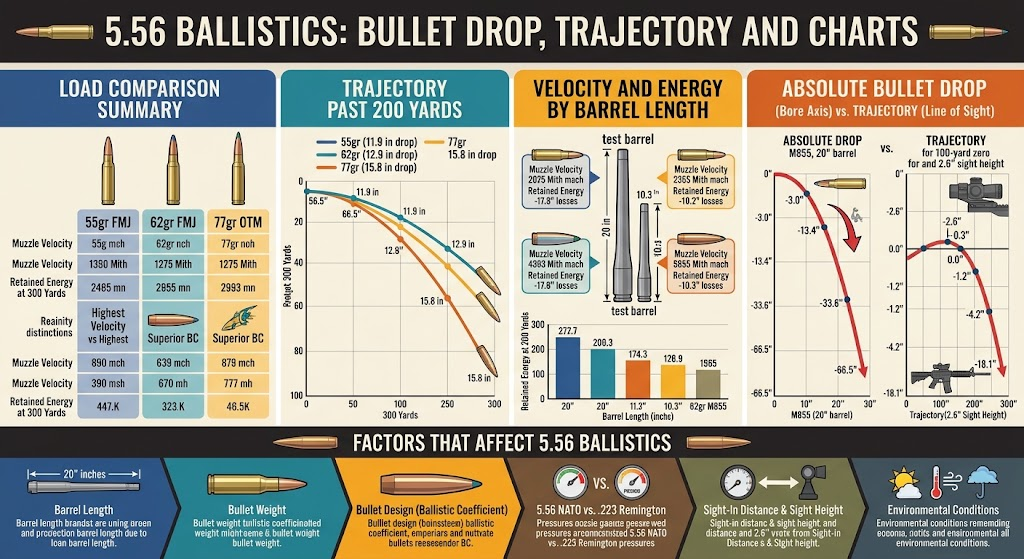
5.56 Ballistics: Bullet Drop, Trajectory and Charts
Understanding 5.56 ballistics requires analyzing how a projectile behaves from the moment it leaves the muzzle until it reaches its target. Performance is heavily influenced by variables such as barrel length, bullet weight, muzzle velocity, and the chosen sight-in distance. By reviewing verified manufacturer data and modeled ballistic tables, shooters can accurately predict 5.56 trajectory and retained energy across practical distances.
Table of Contents
[Click to minimize]
5.56 Ballistics Chart
Bullet Weight
Bullet Type
Manufacturer and Load
Barrel Length
Muzzle Velocity
Velocity at 100 Yards
Velocity at 200 Yards
Velocity at 300 Yards
Velocity at 400 Yards
Muzzle Energy
Energy at 100 Yards
Energy at 200 Yards
Energy at 300 Yards
Trajectory at 100 Yards
Trajectory at 200 Yards
Trajectory at 300 Yards
Ballistic Coefficient
55 Grain
FMJBT
Federal XM193
20 in
3165 fps
2840 fps
2536 fps
2252 fps
1985 fps
1223 ft-lbs
985 ft-lbs
785 ft-lbs
619 ft-lbs
0.0 in (Zero)
-2.8 in
-11.9 in
0.243 (G1)
62 Grain
FMJBT
Winchester M855
20 in
3020 fps
2736 fps
2469 fps
2217 fps
1980 fps
1255 ft-lbs
1030 ft-lbs
839 ft-lbs
676 ft-lbs
0.0 in (Zero)
-3.1 in
-12.9 in
0.304 (G1)
77 Grain
OTM
Black Hills Mk 262 Mod 1
18 in
2750 fps
2530 fps
2320 fps
2120 fps
1930 fps
1293 ft-lbs
1094 ft-lbs
920 ft-lbs
768 ft-lbs
0.0 in (Zero)
-4.2 in
-15.8 in
0.373 (G1)
Analyzing the 5.56 NATO Performance Data
The muzzle velocity ranges from 2750 fps for the heavier 77-grain load up to 3165 fps for the lighter 55-grain load.
Velocity drops significantly over distance, with the 55-grain XM193 losing 913 fps by the time it reaches 300 yards.
Heavier bullets like the 77-grain Mk 262 start slower but retain energy better, boasting 768 ft-lbs at 300 yards compared to the 55-grain load’s 619 ft-lbs.
Bullet trajectory diverges noticeably past 200 yards, with the 55-grain load dropping 11.9 inches at 300 yards while the heavier 77-grain load drops 15.8 inches (assuming a 100-yard zero and a 1.5-inch sight height).
The ballistic coefficient varies widely, from 0.243 for the 55-grain FMJ to 0.373 for the 77-grain OTM, explaining the latter’s superior wind resistance and energy retention downrange.
Shorter barrels produce lower muzzle velocities because the powder has less distance to burn and push the projectile.
Dropping from a 20-inch to a 10.3-inch barrel costs approximately 470 fps in muzzle velocity with standard 62-grain M855 ammunition.
A 16-inch barrel, common on many modern rifles, loses roughly 100 fps compared to the original 20-inch M16 barrel specification.
Muzzle energy drops from 1255 ft-lbs in a 20-inch barrel to just 895 ft-lbs in a 10.3-inch barrel, significantly reducing terminal performance.
5.56 62 Grain Ballistics Chart
Manufacturer and Load
Bullet Weight
Muzzle Velocity
Velocity at 100 Yards
Velocity at 200 Yards
Velocity at 300 Yards
Muzzle Energy
Energy at 100 Yds
Trajectory at 200 Yds
Ballistic Coefficient
Winchester M855 FMJ
62 Grain
3020 fps
2736 fps
2469 fps
2217 fps
1255 ft-lbs
1030 ft-lbs
-3.1 in
0.304 (G1)
Federal Fusion MSR
62 Grain
2750 fps
2480 fps
2226 fps
1987 fps
1041 ft-lbs
846 ft-lbs
-4.3 in
0.310 (G1)
Hornady Black FMJ
62 Grain
3060 fps
2748 fps
2456 fps
2182 fps
1289 ft-lbs
1039 ft-lbs
-2.9 in
0.274 (G1)
62-Grain Performance Overview
The Winchester M855 reaches 3020 fps at the muzzle, while specialized hunting loads like the Federal Fusion MSR launch at a slower 2750 fps from a standard test barrel.
The Winchester M855 retains 1030 ft-lbs of energy at 100 yards, whereas the slower Federal Fusion retains 846 ft-lbs at the same distance.
Trajectory at 200 yards varies slightly among 62-grain options, dropping between 2.9 and 4.3 inches when sighted in at 100 yards.
Ballistic coefficients for 62-grain projectiles generally range from 0.274 to 0.310 depending on the bullet design and profile.
5.56 77gr Ballistics Chart
Manufacturer and Load
Test Barrel
Muzzle Velocity
Velocity at 100 Yds
Velocity at 200 Yds
Velocity at 300 Yds
Muzzle Energy
Energy at 300 Yds
Trajectory at 200 Yds
Ballistic Coefficient
Black Hills Mk 262 Mod 1
18 in
2750 fps
2530 fps
2320 fps
2120 fps
1293 ft-lbs
768 ft-lbs
-4.2 in
0.373 (G1)
IMI Razor Core OTM
18 in
2740 fps
2520 fps
2311 fps
2112 fps
1283 ft-lbs
762 ft-lbs
-4.3 in
0.371 (G1)
Federal Gold Medal Match
20 in
2720 fps
2505 fps
2299 fps
2102 fps
1265 ft-lbs
755 ft-lbs
-4.4 in
0.372 (G1)
Analyzing the Heavier 77-Grain Loads
Heavy 77-grain loads typically leave the muzzle between 2720 and 2750 fps, which is 250 to 300 fps slower than 62-grain military loads.
Due to high ballistic coefficients near 0.373, these projectiles retain velocity efficiently, staying above 2100 fps at 300 yards.
Retained energy at 300 yards is consistently above 750 ft-lbs across all listed 77-grain options.
With a 100-yard zero, 77-grain bullets drop roughly 4.2 to 4.4 inches at 200 yards, requiring slightly more elevation adjustment than faster, lighter rounds.
The 55-grain Federal XM193 offers the highest muzzle velocity at 3165 fps but retains the least amount of energy at 300 yards (619 ft-lbs) among the military styles.
The Hornady TAP Urban, fired from a 16-inch barrel, produces a muzzle velocity of 2990 fps and 1092 ft-lbs of muzzle energy.
The 77-grain Mk 262 generates the highest muzzle energy in this comparison (1293 ft-lbs) and dominates at 300 yards with 768 ft-lbs of retained energy.
Ballistic coefficients vary significantly based on bullet design, ranging from 0.243 for basic 55-grain FMJ up to 0.373 for match-grade 77-grain OTM projectiles.
5.56 Bullet Drop Chart
Distance
Bullet Drop (Absolute)
Remaining Velocity
Remaining Energy
Notes
Muzzle
0.0 in
3020 fps
1255 ft-lbs
Line of departure
50 Yards
-0.7 in
2875 fps
1138 ft-lbs
Drop from bore axis
100 Yards
-3.0 in
2736 fps
1030 ft-lbs
Drop from bore axis
150 Yards
-7.2 in
2601 fps
931 ft-lbs
Drop from bore axis
200 Yards
-13.4 in
2469 fps
839 ft-lbs
Drop from bore axis
250 Yards
-22.1 in
2341 fps
754 ft-lbs
Drop from bore axis
300 Yards
-33.6 in
2217 fps
676 ft-lbs
Drop from bore axis
400 Yards
-66.5 in
1980 fps
540 ft-lbs
Drop from bore axis
Understanding Absolute Bullet Drop
This chart uses Winchester M855 (62-grain) fired from a 20-inch barrel. Bullet drop is measured absolutely from the line of the bore (gravity drop), ignoring the sights.
At 100 yards, the bullet has dropped 3.0 inches below the original line of departure.
By 200 yards, gravity pulls the projectile down 13.4 inches from the bore axis.
At 300 yards, the absolute drop reaches 33.6 inches while velocity decreases to 2217 fps.
By 400 yards, the bullet drops 66.5 inches from the line of departure, showing how rapidly gravity affects the projectile as it slows down.
These figures are based on Winchester M855 (62-grain) from a 20-inch barrel using a 2.6-inch sight height (common for AR-15 optics).
Because the optic is 2.6 inches above the bore, the trajectory starts at -2.6 inches at the muzzle.
At 50 yards, the bullet is 0.3 inches below the crosshairs as it rises to meet the line of sight at 100 yards.
At 200 yards, the trajectory is 4.2 inches below the line of sight, requiring a slight holdover.
At 300 yards, the shooter must compensate for an 18.1-inch drop below the aiming point.
5.56 Trajectory Chart
Distance
Trajectory (1.5″ Sight Height)
Trajectory (2.6″ Sight Height)
Velocity
Energy
Muzzle
-1.5 in
-2.6 in
3165 fps
1223 ft-lbs
50 Yards
-0.1 in
-0.6 in
3000 fps
1099 ft-lbs
100 Yards
0.0 in
0.0 in
2840 fps
985 ft-lbs
150 Yards
-1.0 in
-0.8 in
2685 fps
880 ft-lbs
200 Yards
-3.2 in
-2.8 in
2536 fps
785 ft-lbs
250 Yards
-6.8 in
-6.2 in
2391 fps
698 ft-lbs
300 Yards
-12.1 in
-11.4 in
2252 fps
619 ft-lbs
Sight Height and Trajectory Variations
This chart uses Federal XM193 (55-grain) out of a 20-inch barrel with a 100-yard zero, comparing traditional iron sights (1.5″) against modern optics mounts (2.6″).
At 50 yards, the 1.5-inch sight height puts the bullet 0.1 inches low, while the 2.6-inch sight height puts it 0.6 inches low.
At 200 yards, the lower sight height results in a 3.2-inch drop, compared to a 2.8-inch drop for the taller optic mount.
At 300 yards, the difference is noticeable but small, with drops of 12.1 inches and 11.4 inches respectively.
Factors That Affect 5.56 Ballistics
Barrel length is one of the most critical factors influencing muzzle velocity. Shorter barrels, like those found on 10.3-inch or 11.5-inch rifles, do not allow the gunpowder to burn completely before the bullet exits the muzzle, resulting in slower speeds. Conversely, a 20-inch barrel maximizes powder burn, achieving peak velocities for standard loads.
Bullet weight directly changes both speed and trajectory. Lighter bullets, such as 55-grain options, travel much faster out of the muzzle but shed velocity quickly due to air resistance. Heavier projectiles, such as 62-grain and 77-grain bullets, start slower but utilize their mass to resist wind deflection and maintain velocity over longer distances.
Bullet design dictates the ballistic coefficient, which measures how efficiently a projectile cuts through the air. A bullet with a higher ballistic coefficient, such as an Open Tip Match (OTM) design, will experience less drag than a standard Full Metal Jacket Boat Tail (FMJBT) projectile. This results in less bullet drop and higher retained energy downrange.
While dimensions are nearly identical, 5.56 NATO and .223 Remington are not perfectly interchangeable. 5.56 NATO ammunition is typically loaded to higher pressures and is tested using different parameters than civilian .223 Remington ammunition. Firing 5.56 NATO in a chamber specifically cut for .223 Remington can cause overpressure issues, though firing .223 Remington in a 5.56 NATO chamber is generally safe.
Sight-in distance and sight height determine the arc of your 5.56 bullet trajectory relative to your aiming point. Because the sights sit above the bore, the barrel must be angled slightly upward. This causes the bullet to rise to meet the line of sight, cross it, and eventually fall back down. A taller optic mount requires a steeper upward angle, slightly altering the downrange holdovers.
Environmental conditions change air density, which alters drag. High altitudes, high temperatures, and high humidity reduce air density, allowing a bullet to fly flatter and faster. Wind is the most unpredictable environmental factor, pushing the bullet laterally off target. A heavier bullet with a higher ballistic coefficient resists wind drift better than a lighter, less aerodynamic round.
Frequently Asked Questions
What is the effective ballistic range of 5.56 NATO? For fragmentation and terminal effectiveness with standard military ammunition, the effective range is roughly 150 to 200 yards from short barrels, and up to 300 yards from a 20-inch barrel. For target shooting with heavy match loads, 5.56 NATO can be effective out to 600 yards or more.
How far does a 5.56 bullet drop at 100 yards? If measured as absolute gravity drop from the bore axis, a 62-grain M855 bullet drops about 3 inches at 100 yards. However, if the rifle is zeroed at 100 yards, the bullet will strike exactly at the point of aim (0.0 inches of trajectory drop).
How much does a 5.56 bullet drop at 200 yards? With a 100-yard zero and a 2.6-inch sight height, a standard 62-grain 5.56 bullet drops approximately 4.2 inches at 200 yards depending on barrel length and muzzle velocity.
What is the trajectory of a 5.56 round with a 100-yard zero? With a 100-yard zero and modern optic height (2.6 inches), the bullet starts 2.6 inches low at the muzzle, hits precisely at 100 yards, drops roughly 4 inches at 200 yards, and drops about 18 inches at 300 yards.
How does barrel length affect 5.56 ballistics? Shorter barrels reduce muzzle velocity. Dropping from a 20-inch barrel to a 10.3-inch barrel can cost nearly 500 fps, which dramatically increases bullet drop at distance and reduces retained energy.
What is the difference between 62-grain and 77-grain 5.56 ammunition? 62-grain ammunition (like M855) is lighter, faster at the muzzle, and has a lower ballistic coefficient. 77-grain ammunition (like Mk 262) is heavier, slower at the muzzle, but has a higher ballistic coefficient, allowing it to retain more energy and resist wind drift at longer ranges.
What is the muzzle velocity of 5.56 NATO? Muzzle velocity depends entirely on bullet weight and barrel length. A 55-grain bullet can exceed 3165 fps from a 20-inch barrel, while a 77-grain bullet typically leaves an 18-inch barrel at roughly 2750 fps.
How much energy does a 5.56 bullet retain at 300 yards? A 55-grain XM193 load retains roughly 619 ft-lbs of energy at 300 yards, while a heavier, more aerodynamic 77-grain Mk 262 load retains about 768 ft-lbs at the same distance.
Is 5.56 NATO the same as .223 Remington? No. While their exterior dimensions are practically identical, 5.56 NATO is loaded to higher pressures and features a slightly different chamber throat design. It is not recommended to fire 5.56 NATO in a rifle marked strictly for .223 Remington.
Which factors have the greatest effect on 5.56 bullet drop? Muzzle velocity, distance to the target, and the bullet’s ballistic coefficient are the primary factors dictating bullet drop. Gravity acts on the bullet over time, meaning a faster bullet reaches the target quicker and experiences less total drop.