A .35 Remington ballistics chart tracks the velocity, energy, and bullet drop of a heavy, medium-bore rifle cartridge designed specifically for short-to-medium range hunting in heavy brush. It demonstrates exactly why this round hits like a hammer inside 100 yards, but drops off rapidly past 200 yards due to its blunt bullet design.
.35 Remington Ballistics Chart
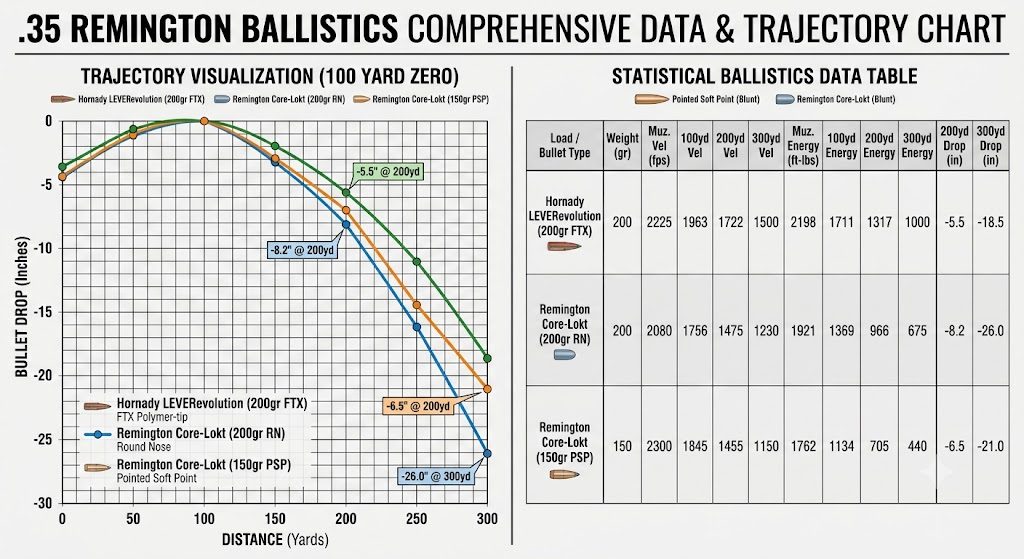
This chart details the performance of the three most common factory loads available for the .35 Remington today, assuming a standard 100-yard zero.
| Manufacturer & Load | Weight (gr) | Muzzle Velocity (fps) | 100 yd Velocity | 200 yd Velocity | Muzzle Energy (ft-lbs) | 100 yd Energy | 200 yd Energy | 200 yd Drop |
| Remington Core-Lokt | 150 Pointed Soft Point | 2300 | 1845 | 1455 | 1762 | 1134 | 705 | -6.5″ |
| Remington Core-Lokt | 200 Soft Point (Round Nose) | 2080 | 1756 | 1475 | 1921 | 1369 | 966 | -8.2″ |
| Hornady LEVERevolution | 200 FTX (Polymer Tip) | 2225 | 1963 | 1722 | 2198 | 1711 | 1317 | -5.5″ |
Understanding the Numbers
When you look at the chart, the defining characteristic of the .35 Remington is how much energy and speed it bleeds off between the muzzle and 200 yards.
The traditional 200-grain Core-Lokt loses roughly a third of its velocity and half of its kinetic energy before it even reaches the 200-yard mark. This happens because the .35 Remington is traditionally loaded with a Round Nose (RN) bullet. It is heavy and wide (creating a massive wound channel upon impact), but aerodynamically, it flies like a brick.
This is where the Hornady LEVERevolution load stands out. By using a modern, flexible polymer tip (the FTX bullet), Hornady gave the .35 Remington a pointed, aerodynamic profile that is still perfectly safe to load in a lever-action’s tubular magazine. The chart shows the result: it starts faster, retains roughly 350 ft-lbs more energy at 200 yards, and drops nearly 3 inches less than the traditional round-nose load.
The History and Use Case
Introduced by Remington in 1906 for their Model 8 semi-automatic rifle, the .35 Remington was designed to be a significant step up in stopping power over the immensely popular .30-30 Winchester.
While it never achieved the sheer volume of sales that the .30-30 did, it carved out a die-hard following among hunters chasing whitetail deer, black bear, and wild hogs in dense forests—often referred to as “the brush.”
Today, it is most commonly found chambered in classic lever-action rifles like the Marlin Model 336. Because shots in heavy timber rarely exceed 75 to 100 yards, the .35 Remington’s poor long-range ballistics are irrelevant. Within its intended range, the heavy 200-grain bullet delivers immediate, bone-crushing energy that anchors game quickly, cementing its legacy as one of the finest woods cartridges ever designed.