If you are stepping up from a smaller caliber or looking into your first big-game hunting rifle, the .308 Winchester is almost certainly on your radar. It is incredibly versatile, widely available, and universally respected. But before you pull the trigger, there is one major question every shooter asks: How bad does it kick?
The short answer is that the .308 Win delivers a firm, heavy shove, but it is generally considered the ceiling of manageable recoil for the average shooter.
The Raw Math: Free Recoil Energy
To look at it objectively, ballisticians measure a cartridge’s Free Recoil Energy in foot-pounds (ft-lbs). This metric depends on bullet weight, powder charge weight, muzzle velocity, and the weight of the rifle itself.
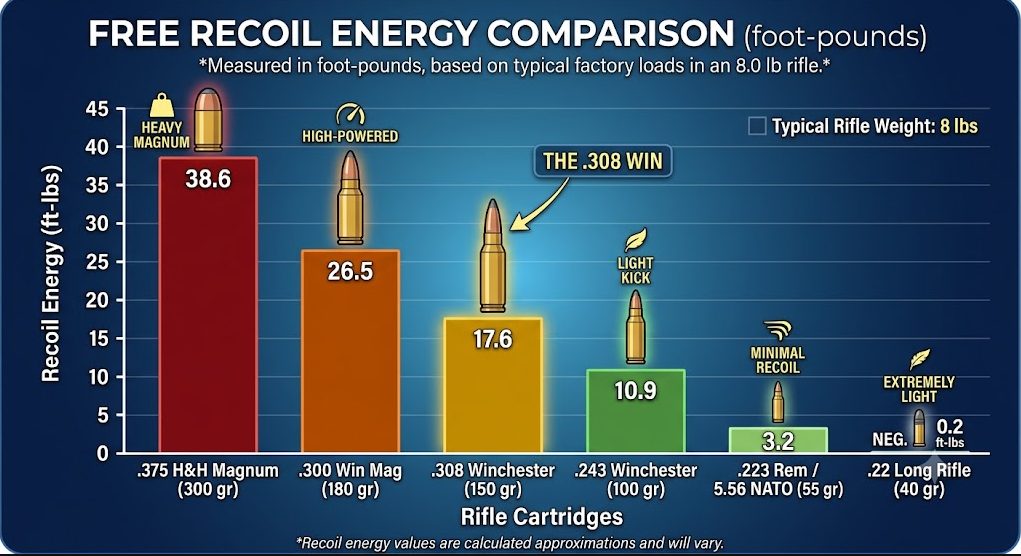
Assuming a standard 8-pound rifle firing a typical 150-grain hunting bullet, a .308 Winchester generates roughly 15 to 18 ft-lbs of free recoil energy.
To give you an idea of where that sits in the grand scheme of rifle cartridges, take a look at how it matches up against other popular rounds:
Perceived Recoil: What Does It Actually Feel Like?
While the physics numbers don’t lie, “felt” or perceived recoil is highly subjective. Most experienced shooters classify the .308 Win as moderate.
- The Comparison: Firing a standard .223 Rem / 5.56 NATO feels like a light tap—the kind of rifle you can shoot all afternoon without a second thought. The .308 Win has roughly three times the recoil energy of a .223. Instead of a tap, it delivers a distinct, solid push into your shoulder pocket.
- The Comfort Threshold: Instructors generally agree that 15 ft-lbs is the threshold where a shooter will start to notice discomfort or potentially develop an involuntary “flinch” (anticipating the kick and jerking the trigger) over an extended range session. Because the .308 sits right at or slightly above this line, it is not an ideal “plinking” round for small-framed individuals or young beginners, but it is entirely tolerable for most adults.
4 Crucial Factors That Alter .308 Recoil
Not every .308 rifle feels the same. If you are worried about the kick, you can manipulate several variables to make the rifle feel significantly softer:
1. Rifle Mass (Weight)
This is the single biggest factor you can control. Heavier rifles absorb kinetic energy before it reaches your body. A heavy tactical or bench rifle weighing 10–12 pounds will make a .308 feel like a breeze. Conversely, an ultra-lightweight mountain hunting rifle weighing 6 pounds will feel significantly snappier and sharper.
2. Bullet Weight & Velocity
A standard 150-grain bullet traveling around 2,800 feet per second (fps) is the baseline. If you jump up to heavy 175-grain or 180-grain loads for larger game, the recoil energy will jump up past 18 ft-lbs. If you want less kick, look for “managed recoil” or light target loads featuring 125-grain projectiles.
3. Action Type
Semi-automatic rifles (like an AR-10 platform) use a portion of the cartridge’s gas and energy to cycle the action and move a heavy buffer assembly. This spreads the recoil impulse over a longer timeframe, making it feel much softer. Bolt-action or single-shot rifles send 100% of that mechanical force straight backward into your shoulder instantly.
4. Muzzle Devices & Accessories
Adding a high-quality rubber recoil pad to the buttstock is the easiest way to cushion the blow. For a more dramatic reduction, adding a muzzle brake can cut felt recoil by 30% to 50% by redirecting the exiting gases sideways rather than letting them push the gun backward (though this makes the rifle significantly louder to anyone standing nearby). Alternatively, a suppressor (silencer) naturally slows down gas expansion, reducing both noise and kick dramatically.
The Verdict: The .308 Winchester kicks hard enough that you must respect it with proper stance and a firm pocket mount. However, its legendary popularity endures precisely because it balances excellent downrange power with a recoil profile that almost any shooter can master with a bit of practice.